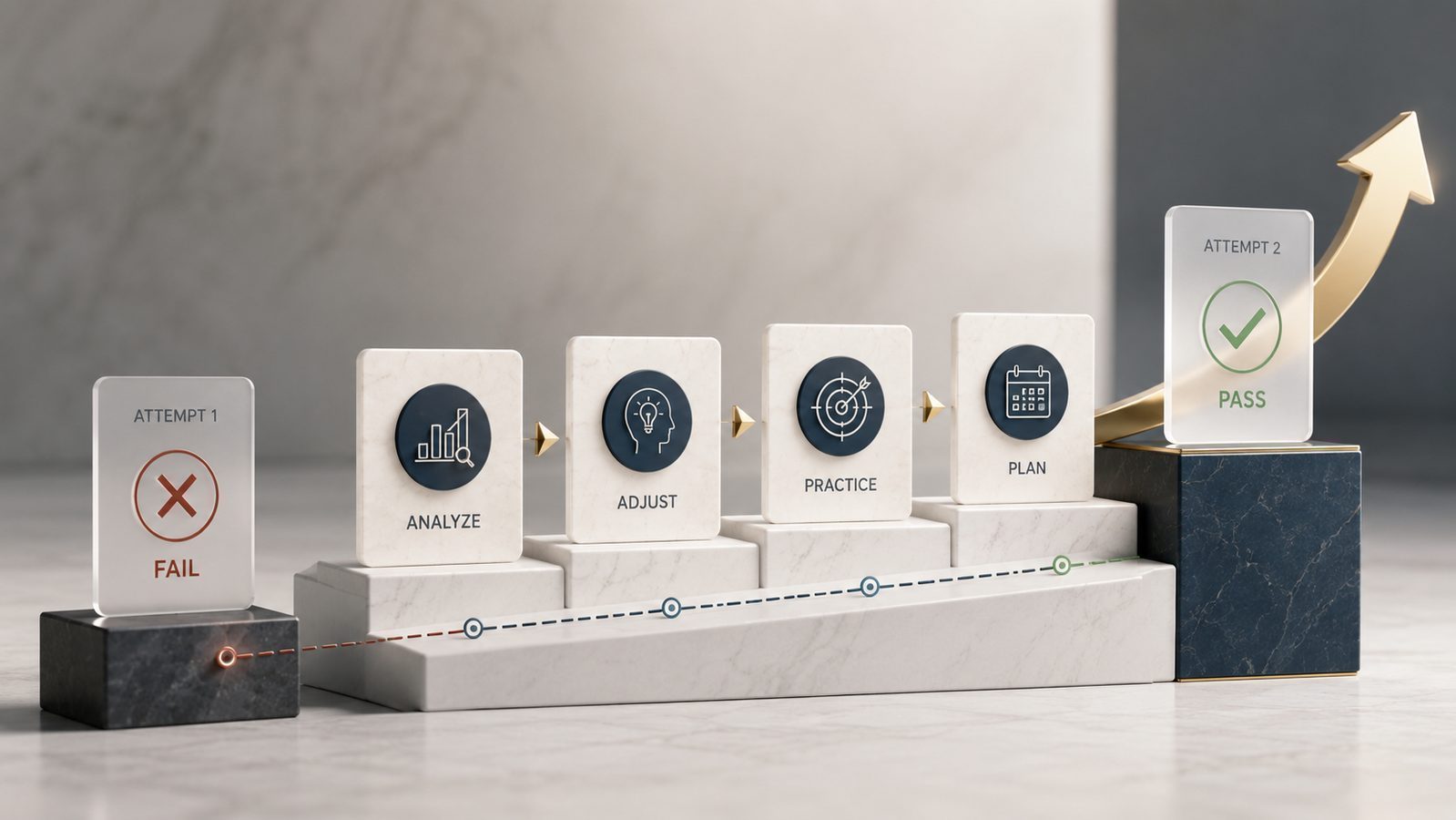
Failing the PMP exam in 2026 does not mean you are a bad project manager, but it does mean your preparation strategy was not aligned with how the current PMP exam is designed. Many candidates who fail the PMP exam on their first attempt later pass on their second attempt after changing how they study, how they analyze questions, and how they approach the PMI mindset.
If you are searching for a PMP retake plan, wondering how long to wait before retaking the PMP exam, or trying to understand what your PMP domain scores actually mean, this guide breaks down what successful second-attempt candidates do differently. The goal is not to study harder. It is to stop repeating the same preparation mistakes that caused the failed PMP exam result in the first place.
PMI allows up to three PMP exam attempts within your eligibility window, but the candidates who pass on attempt two usually make one critical shift: they stop treating the PMP exam like a knowledge test and start treating it like a decision-making exam built around PMI logic, agile thinking, and scenario-based judgment.
Read Your Domain Ratings Before You Plan Anything
When you submit the PMP exam, PMI gives you a Pass or Fail result plus a performance rating for each domain: Above Target, Target, Below Target, or Needs Improvement. These ratings are the most important diagnostic tool you have. Before you book a retake or buy new materials, read them carefully.
The ratings tell you whether the failure was structural or marginal.
If you saw "Needs Improvement" in one domain and "Target" or above in the others, the failure is targeted. Your overall prep was sound, but one specific area let you down. Your retake plan should be a focused intervention on that domain, not a full restart.
If you saw "Below Target" or "Needs Improvement" in two or more domains, the failure is structural. Doubling your study hours on the same materials will not fix it. You need to change your approach, often by switching your primary prep source or adjusting how you read and answer questions.
If you saw "Target" across the board but still failed, you were marginal. The difference is usually pacing, the PMI mindset, or test-day execution rather than content gaps. A short, targeted retake plan focused on full-length practice exams and the PMI mindset often works.
Take a screenshot or write down the ratings before you log out of the PMI dashboard. You will lose access to that screen, and you do not want to rely on memory when planning. Read our PMP Exam Pass Rate 2026 article on how to prepare to pass the exam on the first attempt.
When to Schedule the PMP Retake
PMI allows up to three exam attempts inside a one-year eligibility window. There is a 7-day mandatory wait between attempts, and a retake fee applies. The temptation after failing is either to retake immediately (while it is still fresh) or to push it months out (because you need a break). Neither extreme is usually right.
A working rule:
If the failure was marginal (Target across the board), schedule the retake 3 to 5 weeks out. You need time to address pacing or mindset, but not so long that your content knowledge decays. Marginal failures rarely benefit from months of additional study.
If the failure was targeted (one Needs Improvement domain), schedule the retake 4 to 6 weeks out. You need focused time to rebuild that domain, plus enough buffer to keep the rest of the content fresh through practice.
If the failure was structural (multiple Below Target or Needs Improvement), schedule the retake 8 to 12 weeks out. You need time to rebuild from a different angle, and rushing back in costs you both the exam fee and morale.
Whichever timeline you choose, book the date once. Treat it as fixed. Open-ended retake plans drift forever. The exam date is what forces the prep to converge.
Take at least 48 hours off before you make any decisions. Emotional decisions in the first 24 hours after a failed PMP exam are rarely the right ones. Sleep, eat, talk to someone who is not a project manager, and come back to the data when the immediate disappointment has faded.
A practical PMI rule worth knowing: your one-year eligibility window starts the day PMI approves your application, not the day you first sit the exam. If you fail attempt one six weeks into the window, you have roughly 46 weeks left to use your two remaining attempts. If you fail attempt one ten months into the window, the math gets tight. Check your eligibility expiration date in your PMI dashboard before scheduling the retake. If the window is closing, you may need to retake it sooner than your prep plan would otherwise suggest or pay for a new application after the window expires. PMI does not refund retake fees if you cancel inside 48 hours of the exam, so book the date only when you are confident you can keep it.
What to Change Before the Retake
The single biggest mistake retake candidates make is doing more of the same. If your first attempt was 200 hours of textbook reading and 500 practice questions, doing 300 hours and 800 questions of the same format usually produces the same result. The retake needs a different shape, not just more volume.
Three changes that move the needle:
Shift to questions earlier.
If your first attempt was reading-heavy, flip the ratio. Spend 70 percent of your retake prep on practice questions and explanation review and 30 percent on content. The exam tests applied judgment in scenarios, and the only way to train that judgment is to work scenarios.
Read every explanation, including for the right answers.
Most candidates only read the explanation when they got the question wrong. The explanations for correct answers contain the PMI logic. Reading them surfaces the patterns that show up across questions. After 200 careful explanation reads, the PMI mindset shifts noticeably.
Change your primary source if the failure was structural.
If your main prep was one course or one book and you failed at Below Target in multiple domains, the source itself may be the problem. Switch to a different primary, and keep one secondary for cross-reference. Pre-2026 materials in particular often misalign with the new exam emphasis on Business Environment, AI, and value delivery. Read our article about why using too many study resources are not a good idea.
How to Rebuild the PMI Mindset for Attempt Two
For candidates who failed PMP exam attempts with marginal scores, the underlying issue is often the PMI mindset rather than content gaps. You knew the content. You picked the wrong answer because the right answer was not the one a real-world project manager would choose; it was the one PMI expects. This often happens with smart, experienced project managers who fail the PMP Exam on their first attempt. Read our article about the reasons for this paradox.
Three habits help rebuild the mindset:
Build a "tempting wrong answers" log.
When you choose the wrong answer because it felt right, write down what tempted you. Most candidates fall into the same three or four traps over and over: escalating without analysis, choosing the politically realistic answer, skipping a required step, or matching the wrong methodology to the scenario. Once you see the pattern, you can catch it during the exam.
Practice "predict the answer" before reading the options.
Read the question stem and scenario, predict a one-sentence answer based on the PMI mindset, then look at the options. This forces you to think in PMI logic rather than evaluating which provided option looks closest to what you would do at work.
Track scores by domain and approach (predictive, agile, hybrid).
Many marginal failures come from a methodology mismatch in one part of the exam, often agile content. If your agile scores are 15 points below your predictive scores, that is your highest-leverage retake target.
Key Takeaways
- Your domain ratings are the most important data you have. Read them before booking the retake or buying new materials.
- Marginal failures retake at 3 to 5 weeks, targeted failures at 4 to 6 weeks, structural failures at 8 to 12 weeks. Book the date once and treat it as fixed.
- Take at least 48 hours off before making any retake decisions. Emotional planning on the first day rarely holds up.
- Shift to 70 percent practice questions in retake prep. Read explanations for correct answers, not just wrong ones.
- Change your primary source if the failure was structural. Doing more of the same usually produces the same result.
- For marginal failures, rebuild the PMI mindset through tempting-wrong-answer tracking and "predict the answer" practice.
Retake With a Question Bank Built for the Current Exam
Retake candidates often discover that their practice materials were the bottleneck. Question banks that predate the 2026 ECO no longer match the current exam emphasis on Business Environment, AI in project management, sustainability, and the new question formats. Studying old content for a new exam is the most predictable way to repeat a failed PMP exam result.
Our PMP Exam Simulator offers exam-style questions aligned with the current ECO (the new one for the updated PMP Exam 2026) with detailed explanations. Practice Mode lets you target weak domains specifically, and Exam Mode replicates the real timing, breaks, and question mix so you can rebuild your pacing for attempt two. Start with the free 20-question demo.