Preparing for the PMP exam while working full-time is one of the biggest challenges project management professionals face. Most candidates are balancing meetings, deadlines, family responsibilities, and limited study hours while trying to prepare for one of the most demanding certification exams in the industry.
The problem is usually not intelligence or motivation. It is building a PMP study plan that realistically fits around a full-time job without burning out after a few weeks. This article gives you that system. We will cover how to set a realistic timeline, build a weekly schedule that survives bad days, choose high-leverage study activities, and recover when work blows up your plan.
Set a Realistic Timeline Based on Your Starting Point
The first mistake working professionals make is committing to a study window that ignores their starting point. Project management experience shapes how long you need. PMP prep providers describe a wide range: candidates with several years of hands-on project work often need fewer hours than those new to formal project management.
A practical way to set your timeline is to be honest about three variables: how many years you have managed projects, how comfortable you are with agile and hybrid approaches, and how many hours you can realistically protect each week.
If you average ten to fifteen study hours per week, a three to four month window is the range many prep providers recommend for working candidates. Cutting that to six weeks is possible, but only if you can carve out twenty plus hours weekly, which most full-time workers cannot sustain without serious cost.
Block out your timeline on a calendar before you do anything else. Pick a target exam date, work backward, and mark milestones: finish the first content pass at week six, complete the first full-length practice exam by week eight, and reserve the last two weeks for targeted review and timed tests.
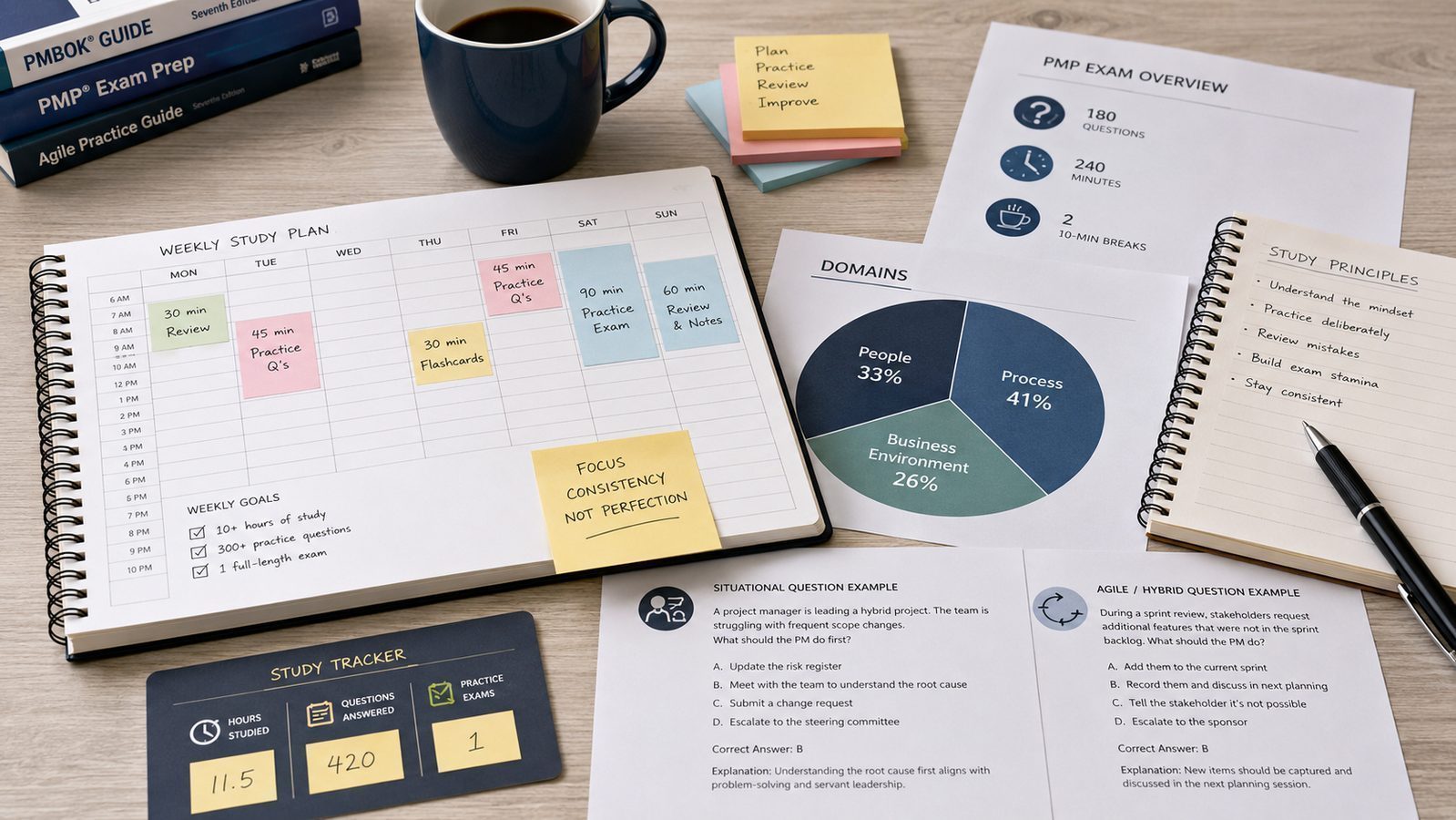
The PMP exam in its current format consists of 180 questions over 240 minutes, with two 10-minute breaks built in. Whatever timeline you choose, your prep needs to include enough timed practice to make that pace feel natural on test day.
How to Build a PMP Study Schedule While Working Full-Time
The schedule that works for full-time professionals is one designed for the worst week, not the best one. If your plan assumes you will study two focused hours every weekday after work, the first late client call will break it and you will lose momentum.
Build your week around three types of study blocks:
- Anchor blocks. One or two longer sessions of 90 to 120 minutes on weekends or a guaranteed weekday evening. This is where you do new content and longer practice sets.
- Maintenance blocks. Three to four shorter weekday sessions of 30 to 45 minutes. These are for review, flashcards, and short question batches.
- Recovery slots. Thirty-minute windows you leave unscheduled but committed. When work explodes and you miss an anchor block, you use a recovery slot to catch up.
Treat anchor blocks as meetings on your calendar. Send yourself a calendar invite, mark it busy, and protect it the way you would protect a stakeholder review. Studying after the kids go to bed sounds noble until exhaustion wins three nights in a row.
The morning is often the most reliable window for full-time workers. A 6:30 AM start before email opens is harder to schedule but easier to defend, because no one books meetings against your alarm clock.
Track two numbers each week: total study hours and number of practice questions answered. If either drops below your minimum target for two weeks in a row, your schedule is broken, and you need to redesign it, not push harder.
Avoid the multi-tasking trap. Watching a PMP lecture while answering Slack is not studying. Forty-five minutes of focused work beats two hours of split attention. Most candidates underestimate this and overestimate their actual focused hours.
Use commute time, if you have one, for passive review only: podcasts, audio lectures, or recorded explanations of concepts you already studied. Save active study (reading new content, working on questions) for blocks where you can fully concentrate.
Why PMP Practice Questions Matter More Than Reading
Most working professionals run out of time and feel they did not finish "the material." The fix is to invert the usual approach. Spend less time reading the PMBOK Guide cover to cover and more time working practice questions early in your prep.
Practice questions teach you three things that reading cannot. They show you how PMI frames problems, which is often different from how you would describe the same situation at work. They expose the gaps in your understanding faster than rereading a chapter. And they build the stamina you need for a 240-minute exam.
A workable ratio for busy candidates is roughly 30 percent content study and 70 percent practice questions and review, especially in the back half of your prep. Front-load some reading so the questions make sense, then shift weight aggressively toward practice.
When you answer a question, do not just check the right answer. Read the explanations. The PMP exam is largely situational, and many wrong answers are not wrong because of policy or formula but because they do not match PMI's preferred response in a scenario. Understanding why a tempting wrong answer is wrong is where most learning happens.
Track your practice scores by domain (People, Process, Business Environment) and by question type (predictive, agile, hybrid). The current exam includes a meaningful share of agile and hybrid content. If your agile scores are 20 points lower than your predictive ones, that is your next study target, not another general read of the PMBOK Guide.
Our deeper analysis of what practice exam scores actually predict covers the score thresholds and patterns that correlate with passing.
Take at least 2-4 full-length, 180-question timed practice exams before test day, with breaks at the same points the real exam uses. This is the only way to know whether your pacing and focus hold up over almost four hours.
How to Stay Consistent With PMP Prep During Busy Work Periods
Every multi-month prep plan hits at least one bad week. A launch slips, a key person leaves, and a client emergency consumes a weekend. Working professionals who pass usually have a recovery routine, not a perfect record.
When work overruns your study time, do not try to make up the hours all at once. The catch-up plan creates a worse rebound the following week. Instead, hold the bottom line.
Minimum viable study during a crisis week:
- Thirty minutes of practice questions, four days that week. Total: two hours.
- Skip new content. Review only.
- Do not skip the next weekend anchor block, even if you only do half of it.
This keeps your knowledge from decaying and protects the habit. The habit is the thing that matters most over a three to four month window.
If a single bad week becomes three in a row, your timeline needs to shift, not your weekly hours. It is better to push your exam date by four weeks than to walk in undercooked because you refused to adjust. PMI lets you reschedule, and the cost of a delay is far smaller than the cost of failing and retaking.
Common Mistakes When Studying for the PMP Exam While Working Full-Time
A few patterns appear over and over in candidates who do not finish their prep or who finish but underperform.
Studying without a target exam date. Without a booked exam, the timeline expands forever. Schedule the exam in PMI's system once you know your starting point. Treat the date as fixed.
Buying multiple courses and finishing none. Pick one main course and one-two main question banks. Finishing one full course beats sampling three. Course-hopping is procrastination in productive clothing.
Ignoring agile content. The current exam expects fluency in agile and hybrid project work. If you have only worked in predictive environments, agile is your highest-leverage gap.
Treating the PMBOK Guide as the primary source. It is one reference, not a textbook. PMI's PMP Examination Content Outline is the authoritative scope document. Read it once, then refer back to it when you plan study sessions.
Burning out by month two. The candidates who finish the marathon are usually the ones who took one full rest day a week from the start. Studying seven days a week for fourteen weeks is not sustainable for most full-time workers.
For candidates with high baseline experience and very limited time, our intensive 27-day PMP prep case study shows what an unconventional, focused approach can look like.
How Many Hours Should You Study for the PMP Exam While Working Full-Time?
Most working professionals preparing for the PMP exam spend between 120 and 180 total study hours, depending on prior project management experience, familiarity with agile delivery, and English proficiency. PMI requires project experience before eligibility, but real-world experience alone is rarely enough to pass the exam without structured preparation.
Key Takeaways
- Set your timeline based on your actual PM experience and weekly hours available. Three to four months is realistic for most working professionals at 10 to 15 hours per week.
- Build a weekly schedule with anchor blocks, maintenance blocks, and recovery slots. Protect anchor blocks like client meetings.
- Shift to roughly 70 percent practice questions and review by the second half of your prep.
- Track scores by domain and approach type (predictive, agile, hybrid). Study your weakest area, not the easiest one.
- Have a minimum viable study routine for bad weeks. Reschedule the exam rather than walking in unprepared.
- Avoid course-hopping, ignoring agile content, and skipping rest days.
Put the Plan Into Practice
Knowing how to study for the PMP exam while working full-time is half the work. Putting the system into practice is the other half. The candidates who pass are not the ones with the most free time. They are the ones who build a focused, repeatable routine and protect it from the chaos of a regular workweek.
If you are ready to put these strategies into practice, pmproad.com offers new exam-style questions (updated for PMP Exam 2026) across all three domains, with detailed explanations that show why each answer is right or wrong. Practice Mode lets you build skill by topic, and Exam Mode replicates the real timing and break structure so you can train your pacing before test day.
Start with the free 20-question demo. No registration, no credit card, and an honest read on where your preparation stands today.