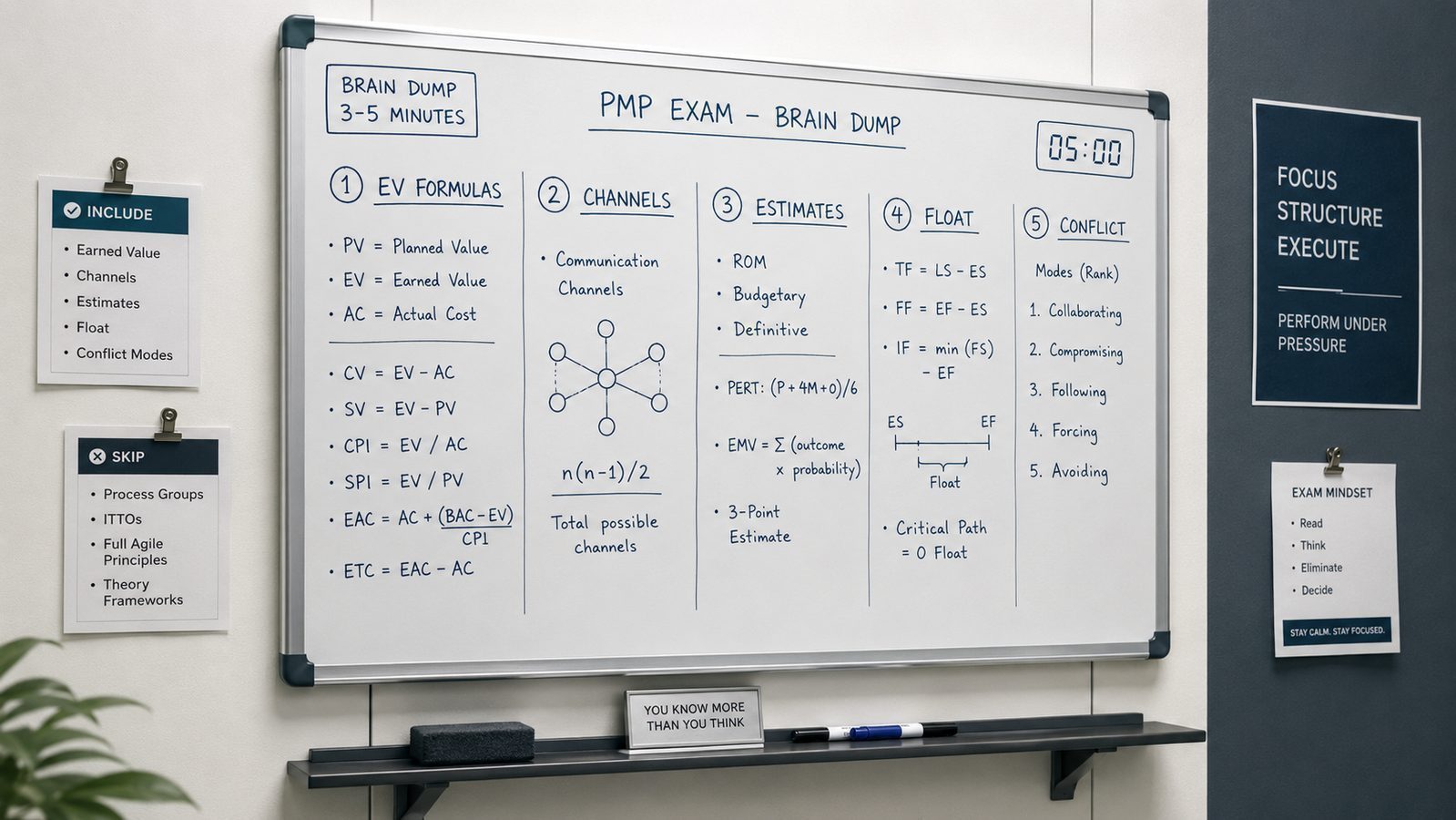
The PMP brain dump strategy is still one of the most debated PMP exam tactics. Some candidates swear by writing formulas and key concepts into the exam notepad during the first few minutes of the test. Others think it wastes valuable exam time.
The truth is somewhere in the middle. A good PMP brain dump can reduce mental load and help you move faster through formula-based questions. A bad one turns into 15 minutes of panic-writing that you never use again. The key is knowing exactly what to write, what to skip, and how to keep the process under five minutes.
Does the PMP Brain Dump Still Work in 2026?
The original brain dump tactic comes from the earlier paper-based PMP exam era, when candidates had physical scratch paper, a longer exam, and more flexibility for note-taking. Today, the PMP exam is computer-based and can be taken either online or at a Pearson VUE test center.
For the online proctored exam, physical scratch paper is not allowed. Instead, candidates use a built-in digital whiteboard/notepad within the testing interface, which has limited screen space and basic formatting tools. At a test center, candidates are typically provided with an erasable noteboard or laminated booklet and marker for note-taking, although personal paper and pens are not permitted.
Three things go wrong with most brain dumps:
They take too long. Spending 20 minutes on a brain dump is 26 questions of exam time at your target pace. If you do not use the brain dump enough during the exam to earn back those 26 questions of insight, you lost net.
They include content the exam does not test in a way that benefits from notes. Memorizing process groups in a table looks impressive on paper. On the exam, a question rarely asks, "Which process group includes the Develop Project Charter process?" It asks situational questions where having the table on screen does not help.
They are unstructured. A wall of text on a small digital notepad is hard to scan during the exam. If you cannot find the relevant note in 5 seconds, you will not use it.
A useful PMP brain dump is short (under 5 minutes), structured (clear sections), and limited to content where having it in writing actually helps you with a question.
What to Include in Your PMP Brain Dump
The items that benefit from being written down at the start of the exam are the ones that are:
- Easy to forget under stress (specific numbers, formula symbols).
- Reused across multiple questions (formulas, key conversions).
- Faster to look up than to recalculate (cost variance signs, performance index interpretations).
A practical inclusion list:
Earned value formulas with sign conventions.
EV, PV, AC, CV (EV minus AC), SV (EV minus PV), CPI (EV divided by AC), SPI (EV divided by PV), EAC (multiple formulas depending on assumption), ETC, VAC. Include the sign convention for variances: positive means under budget or ahead of schedule, negative means over budget or behind schedule. Include the index thresholds: 1.0 is on plan; above is favorable; below is unfavorable. Check our article on most important PMP math questions.
Communication channels formula.
Number of channels equals n times (n minus 1) divided by 2, where n is the number of stakeholders. Easy to forget if the question describes a team growing from 5 to 10 people and asks how many new channels appear.
Three-point estimating formulas.
Triangular: (P + M + O) divided by 3. Beta (PERT): (P + 4M + O) divided by 6. Standard deviation: (P minus O) divided by 6.
Float calculations.
Total float equals LS minus ES (or LF minus EF). Free float is the time an activity can slip without delaying the next activity.
Conflict resolution modes ranked.
Collaborating/problem-solving (preferred), compromising, smoothing/accommodating, forcing, withdrawing/avoiding. PMI prefers collaborating in most scenarios. Useful to glance at when a people-domain question asks how to handle a team conflict.
That is roughly the full inclusion list. Five categories, all formula-heavy or convention-heavy, all useful across multiple questions, all hard to derive under stress.
What NOT to Write in Your PMP Brain Dump
Items that do not benefit from being written down:
Process groups and knowledge areas table.
The exam tests application of processes in scenarios, not recall of which process belongs to which group. The table is too large for the digital notepad, and questions rarely use language like "in which process group does X happen."
ITTOs (inputs, tools and techniques, outputs).
The exam does not test memorized ITTOs. It tests judgment about which input or output matters in a scenario. Writing them down costs time you cannot recover.
Agile values, manifesto, and principles in full.
You can list them in 2 minutes if needed, but reproducing them on the notepad takes longer than they save. Better to internalize the principles during prep so you recognize them in a question.
Theory frameworks (Tuckman, Maslow, Herzberg).
These appear in some questions, but rarely in a way that requires the names of the stages or levels written on screen. If you know the framework, you will recognize it in the question. If you do not, writing it down at the start does not help.
The general rule: if having the content on screen does not save you time on at least three questions during the exam, do not include it in the brain dump.
How to Time and Use Your PMP Brain Dump
Write the brain dump in the first 3 to 5 minutes after the exam starts. The exam timer is running, so every minute on the brain dump is a minute off your question time. Five minutes is the upper limit. If your brain dump cannot fit in five minutes, it is too long.
Type with clear headers (EV FORMULAS, CHANNELS, ESTIMATES, FLOAT, CONFLICT) so you can scan to the right section quickly. Capital letters are faster to scan than mixed case.
During the exam, glance at the notepad only when a question explicitly needs a formula or convention you wrote down. Do not open it for situational questions where the answer comes from the PMI mindset, not from notes.
If you find you did not look at the brain dump once during the first section, that is a signal that for the next section you should make it shorter. If you looked at it constantly and it helped, keep it.
For candidates building the broader exam day plan, our PMP Vocabulary Guide covers terms you must know to pass the exam.
A practical routine that locks the brain dump in before test day: write it from memory at the start of every full-length practice exam in the last two weeks of prep. Use a timer. The first two attempts will probably take 7 to 8 minutes and miss a category. By the fourth attempt, you should be at 3 to 4 minutes with all five categories in place and clearly formatted. If you cannot get to 5 minutes after four tries, the brain dump is too long for you. Drop one of the categories you used least during the practice exam itself and rerun the test. This is the same principle as any well-prepared playbook: simulate before you need it, not during the moment that counts.
Key Takeaways
- The PMP brain dump is useful when it is short, structured, and limited to content that saves time on real questions.
- Include earned value formulas, the communication channels formula, three-point estimating, float calculations, and conflict resolution modes.
- Skip process group tables, ITTOs, agile principles in full, and theory frameworks. They cost time without earning it back.
- Time the brain dump at 3 to 5 minutes. Five minutes is the upper limit.
- Use clear headers and capital letters so you can scan in 5 seconds during a question.
- If you did not look at the brain dump during the first section, make it shorter next time.
How to Practice Your PMP Brain Dump Before Exam Day
The brain dump only works if you have practiced writing it under timed conditions. The candidates who fumble it on exam day are usually the ones who never wrote it out under a stopwatch during prep. Three or four timed runs is usually enough to lock in the items and the order.
pmproad.com Exam Mode replicates the real PMP exam interface, so you can practice your brain dump in the actual format you will use on test day. Practice Mode covers the formulas and concepts behind each brain dump category, with explanations that show why each formula matters in the questions PMI writes.
Start with the free 20-question demo. No registration, no credit card, and an honest read on how your prep stands against exam-format questions. If the brain dump is part of your strategy, run it inside your first full-length Exam Mode session and time yourself end to end.