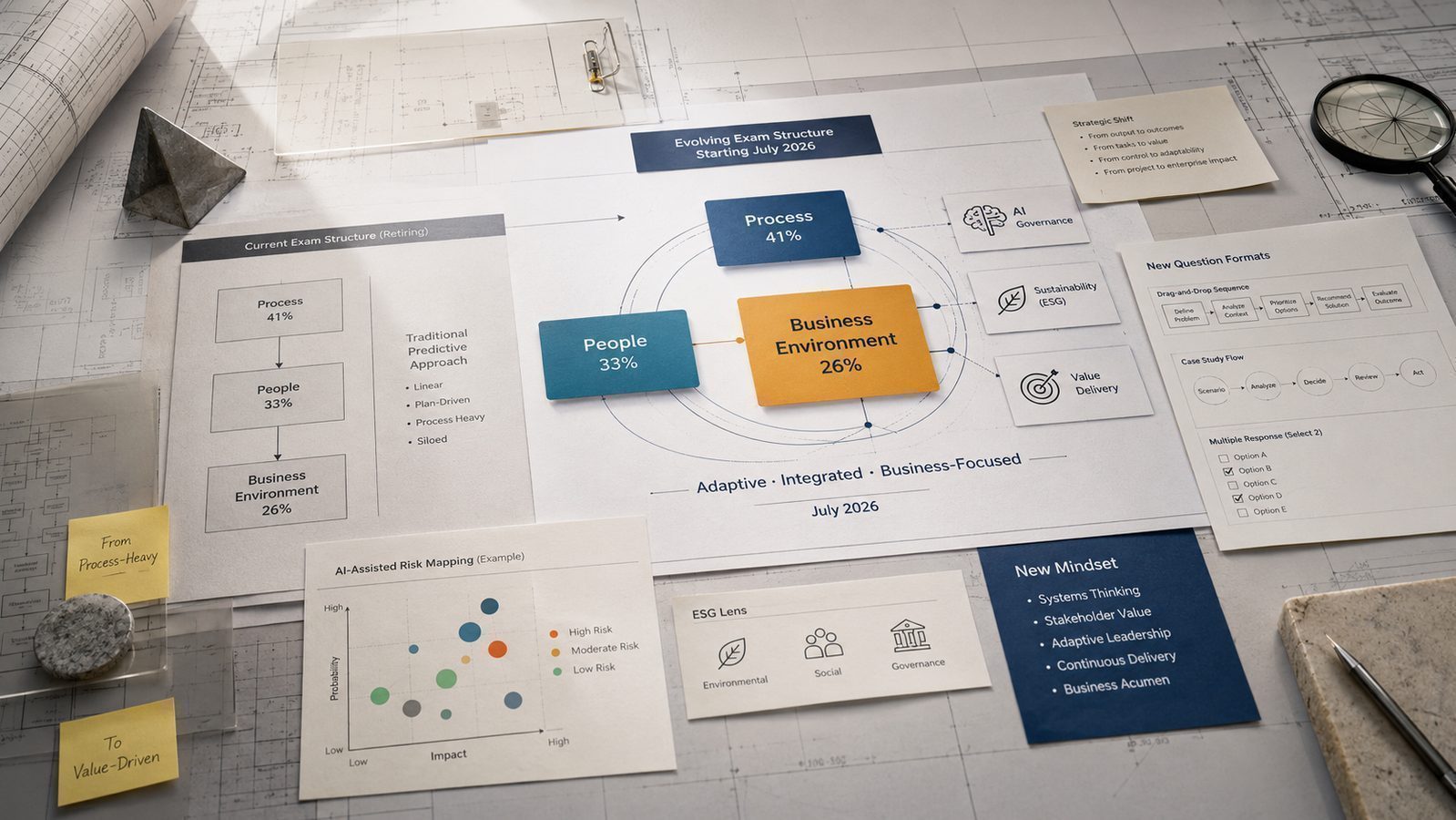
On July 9, 2026, PMI launches the new version of the PMP exam. If you are testing on that date or later, you are sitting for a different exam than anyone who tested before. The structure shifts, the content scope expands, and several new question formats appear that the old exam did not use.
The PMP exam changes for July 2026 are the largest update PMI has rolled out since 2021. They affect what you study, how you study it, and which study materials are still useful. If you are mid-prep and plan to test after July 8, you need to know what is changing and what to do about it. This article breaks down the four areas that matter most: the new domain weightings, the new content areas (AI, sustainability, value delivery), the new question formats, and how to adjust your study plan to match.
What Changes on July 9, 2026
PMI publishes the scope of the PMP exam in a document called the Examination Content Outline (ECO). Anyone who tests on July 8 or earlier sits for the current exam. Anyone who tests on July 9 or later sits for the new one. There is no transition period and no choice once the date passes.
At a high level, four things change:
- The three domains stay the same (People, Process, Business Environment), but their weightings shift significantly. The Business Environment domain roughly triples.
- The task list inside each domain is consolidated. The new ECO lists 26 tasks instead of the previous 35.
- New content areas appear inside the existing domains. AI in project management, sustainability and ESG considerations, and value delivery move from "nice to know" to testable.
- The exam introduces new question formats. Case-study sets, drag-and-drop, matching, point-and-click, and graphic interpretation appear alongside the multiple-choice items that dominated the old exam.
The total question count stays at 180. The cost does not change. Eligibility requirements do not change. What changes is everything between booking the exam and clicking "submit."
New Domain Weightings: Business Environment Triples
The most significant structural change in the PMP exam changes for July 2026 is the rebalanced domain weighting. The shift looks like this:
- People falls from 42 percent to 33 percent.
- Process falls from 50 percent to 41 percent.
- Business Environment rises from 8 percent to 26 percent.
In practical terms, Business Environment goes from a small slice you could almost skim to one of the three pillars of the exam. Out of 180 questions, roughly 47 now come from Business Environment, up from roughly 14 before.
This matters for how you allocate study time. If your prep is built around the current ECO, you are over-invested in People and Process content and under-invested in Business Environment. A candidate who used to spend 5 to 10 percent of prep time on the Business Environment domain now needs closer to 25 percent.
The Business Environment domain also expands beyond its previous scope. It now covers organizational strategy alignment, regulatory and compliance considerations, governance, value delivery to the organization, and adapting projects to external change. The shift signals PMI's view that modern project managers operate inside a wider business context, not just inside a project team.
If you have not booked your exam date yet and you are weighing whether to test before or after the change, our decision guide on the 2026 transition covers the trade-offs in detail.
New Content Areas: AI, Sustainability, and Value Delivery
The new ECO does not just rebalance old content. It adds new content. Three areas appear that the previous exam did not test in any meaningful way.
AI in Project Management
The new exam tests how AI tools support project work. Expect questions on AI use in scheduling, risk identification, resource optimization, and decision support. You do not need to memorize specific tools or vendors. You do need to recognize when AI augments human judgment, when its output should be questioned, and how a project manager governs AI use inside a project. Ethical considerations and AI governance appear primarily inside the Business Environment domain.
Sustainability and ESG
Environmental, social, and governance considerations appear across multiple tasks. The exam may include scenarios about sustainability metrics, green project management practices, stakeholder expectations around responsible delivery, and how to factor ESG goals into project planning and reporting. You do not need to be an ESG specialist. You need to be able to recognize when sustainability is a constraint, a stakeholder requirement, or a value driver, and respond appropriately.
Value Delivery
The new ECO emphasizes value delivery as a primary lens. Many tasks now frame project success in terms of business outcomes and benefits realization, not only on-time and on-budget completion. Expect questions where the correct answer aligns with the option that maximizes value to the organization or stakeholder, even when it deviates slightly from a textbook process step.
These three areas carry the highest risk for candidates relying on older study materials. Most pre-2026 question banks, textbooks, and bootcamps were built before this content was testable. If your study materials do not cover AI, sustainability, and value delivery, you are missing roughly a quarter of the new exam's scope.
New PMP Exam Question Formats
The new exam expands the mix of questions considerably. Expect to see:
- Case-study or scenario sets. A single scenario unfolds across multiple linked questions, and your earlier answers may shape later ones.
- Drag-and-drop items. Order steps, match concepts, or assemble a sequence.
- Matching items. Pair items in two columns.
- Point-and-click and graphic interpretation. Click on a part of a diagram, chart, or visual to answer.
These formats reward different skills than pure recall. They test how you read a situation, how you weigh competing factors, and how you reason through a sequence. Memorizing definitions will not help you on a drag-and-drop sequencing question or a scenario set that requires you to follow a thread across several screens.
The implication for your prep is direct: timed practice with realistic question formats matters more than ever. Reading the PMBOK Guide and reviewing flashcards prepares you for one kind of question. Working through scenario sets, sequencing problems, and visual interpretation items prepares you for the rest. If your practice bank does not include these formats, you will see them for the first time on test day, which is the worst place to discover a new format.
How to Adjust Your Study Plan for the PMP Exam Changes July 2026
If your exam date is July 9, 2026 or later, three adjustments matter most.
Rebalance your domain time. Increase your Business Environment study allocation from roughly 10 percent to roughly 25 percent. Pull that time from People and Process content where you already feel solid. Track your practice scores by domain so you can spot the gap early instead of discovering it on a mock exam two weeks before test day.
Add the new content. Make sure your materials cover AI in project management, sustainability and ESG basics, and value delivery as a planning lens.
Practice the new question formats. Look for question banks that include scenario sets, drag-and-drop, matching, and graphic interpretation. Take at least one full-length practice exam built for the new format before test day so you are not adapting to a new interface under timed pressure.
A practical timeline check: if your test date is after July 9 and you have not yet updated your study materials, do that before you write your next study session. Studying old content for a new exam is a slow way to fail.
Once you have your plan in place, our proven study strategies for first-attempt success covers the routines that work across both exam versions.
Key Takeaways
- The new PMP exam launches July 9, 2026. Anyone testing on or after that date sits for the new ECO.
- Domain weightings shift: People 33 percent, Process 41 percent, Business Environment 26 percent. Business Environment roughly triples.
- New content areas appear: AI in project management, sustainability and ESG, and value delivery.
- New question formats appear: case-study sets, drag-and-drop, matching, point-and-click, graphic interpretation.
- Question count stays at 180. Cost and eligibility do not change.
- If you are studying for a post-July 9 exam, rebalance toward Business Environment, add the new content areas, and practice on the new question formats before test day.
Prep With Materials Built for the New Exam
Studying old content for a new exam is the most common reason candidates underperform during a major ECO transition. The 2021 update caught a wave of candidates with outdated materials, and the 2026 update is a larger change. The fix is making sure every hour you put in maps to the exam you will actually sit for.
The pmproad.com question bank has been rebuilt to match the new ECO that takes effect July 9, 2026. The platform now includes questions in the new formats: scenario sets, drag-and-drop, matching, hot-spot, and graphic interpretation items. The interface itself has also been refreshed for a cleaner, faster experience on both desktop and mobile. Practice Mode lets you target weak domains, and Exam Mode replicates the new exam timing, breaks, and question mix.
Start with the free 20-question demo. No registration, no credit card, and an honest read on where your prep stands against the new exam.