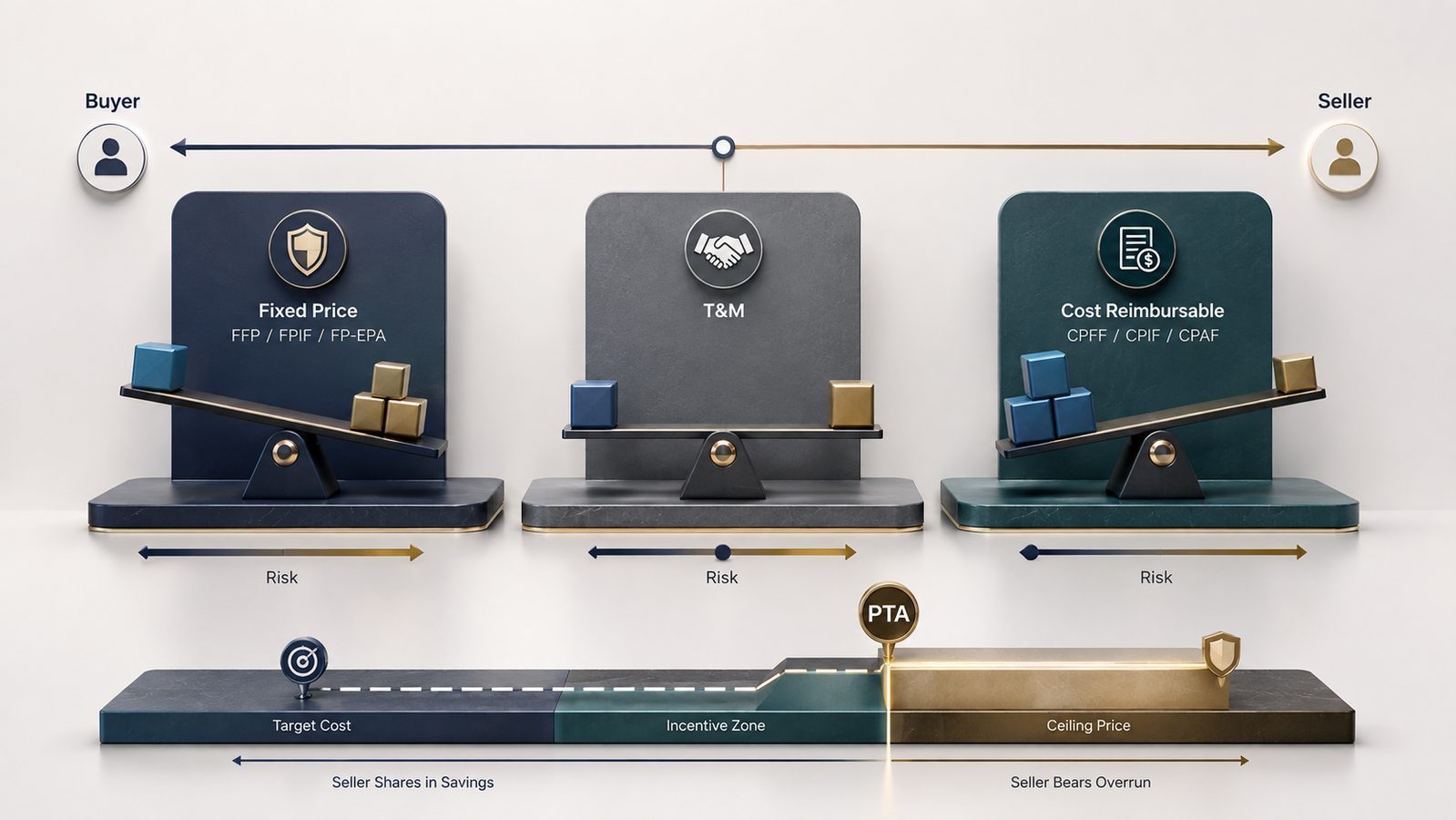
PMP procurement contract types show up on the exam in a specific way: a scenario describes a buyer and a seller, names or implies a contract structure, and asks you to identify who carries the financial risk or what happens next when costs change. Candidates who memorized the acronyms, FFP, CPFF, T&M, without connecting them to who actually absorbs a cost overrun tend to guess wrong under pressure. This article covers the three contract families PMI expects you to know, how risk shifts between buyer and seller in each one, and the point of total assumption formula, the calculation most likely to appear as a numeric question rather than a conceptual one.
Where Procurement Fits in the 2026 Exam
The current PMP Examination Content Outline organizes the exam into three domains: People, Process, and Business Environment, weighted at roughly 33%, 41%, and 26%. Procurement sits inside the Process domain alongside schedule, cost, and risk. The exam itself runs 180 questions over 240 minutes, made up of 170 scored items and 10 unscored pretest items, with two optional 10-minute breaks built into the session.
Procurement questions rarely ask you to draft a contract. They ask you to reason about one: given a described arrangement, who bears the risk if the work costs more than planned, and what does that imply about which party has an incentive to control costs. That framing is why the risk allocation logic in this article matters more than memorizing every acronym.
Fixed Price Contracts: The Seller Carries the Risk
In a fixed price contract, the buyer and seller agree on a set price for a defined scope of work before the work begins. If the seller's actual costs run higher than expected, the seller absorbs the difference. This structure gives the seller a strong incentive to control costs and deliver efficiently, and it gives the buyer cost certainty going into the project.
PMI recognizes three subtypes. Firm Fixed Price, FFP, is the simplest: one price, no adjustments regardless of what the seller's actual costs turn out to be. Fixed Price Incentive Fee, FPIF, adds a performance incentive on top of a base price, letting the seller earn more for hitting cost, schedule, or technical targets, while still capping the buyer's exposure at a ceiling price. Fixed Price with Economic Price Adjustment, FP-EPA, is used for long-term contracts where a special clause allows the price to be adjusted for changes in cost drivers outside the seller's control, such as inflation or material price increases, protecting the seller from conditions it cannot manage. Across all three subtypes, the defining pattern for exam purposes is the same: the seller carries most of the cost risk, and the buyer's exposure is capped or fixed.
Cost Reimbursable Contracts: The Buyer Carries the Risk
A cost reimbursable contract flips that risk allocation. The buyer agrees to pay the seller's actual allowable costs plus a fee, so if the work costs more than expected, the buyer absorbs the difference rather than the seller. Buyers use this structure when the scope is not well defined early on, which is common in research, new technology, or highly uncertain work where a fixed price would force the seller to pad estimates heavily just to cover unknown risk.
The three subtypes differ in how the fee is set. Cost Plus Fixed Fee, CPFF, pays the seller a fee that is agreed in advance and does not change even if actual costs run higher or lower, though the fee can be adjusted if the scope of work itself changes. Cost Plus Incentive Fee, CPIF, ties part of the seller's fee to performance against a target cost, sharing both savings and overruns between buyer and seller according to a pre-agreed ratio. Cost Plus Award Fee, CPAF, bases most or all of the fee on a subjective evaluation of the seller's performance by the buyer, based on criteria defined in the contract rather than a mechanical formula. When a question describes a scenario where the buyer is absorbing cost growth or evaluating the seller's fee based on satisfaction ratings, that is a cost reimbursable signal, not a fixed price one.
Time and Materials: Risk Split Down the Middle
Time and Materials contracts, often written as T&M, sit between the other two families. The buyer pays a fixed rate per unit of labor or material, but the total quantity of work is not fixed in advance. This makes T&M a hybrid: the unit rate is fixed, similar to a fixed price element, but the total contract value is open-ended like a cost reimbursable arrangement, since nobody knows exactly how many hours or units the work will ultimately take. PMI describes this as sharing risk between buyer and seller. The seller is protected from being underpaid for the rate of work performed, while the buyer is exposed to the total cost climbing if the work takes longer than expected.
T&M contracts are common for staff augmentation, maintenance work, or any engagement where the scope is not fully known when the contract is signed. On the exam, a scenario describing an hourly rate combined with an uncertain total duration or quantity is the clearest signal that the correct answer is Time and Materials, not Fixed Price or Cost Reimbursable.
Point of Total Assumption: Where Fixed Price Incentive Contracts Change Behavior
The point of total assumption, PTA, applies specifically to Fixed Price Incentive Fee contracts. It marks the cost point above which the seller absorbs all further cost overruns, because the ceiling price has effectively capped how much more the buyer will pay. Below the PTA, cost overruns are shared between buyer and seller according to the agreed share ratio. Above it, the seller is on the hook for every additional dollar, since the contract's ceiling price does not move.
The formula is: PTA = ((Ceiling Price − Target Price) / Buyer's Share Ratio) + Target Cost
Here is a worked example. Suppose a contract has a target cost of $150,000 and a target fee of $10,000, giving a target price of $160,000. The ceiling price is set at $170,000, and the share ratio is 70/30, meaning the buyer absorbs 70% of any cost overrun up to the ceiling and the seller absorbs 30%. Plugging into the formula: PTA = (($170,000 − $160,000) / 0.70) + $150,000 = ($10,000 / 0.70) + $150,000 = $14,286 + $150,000 = $164,286.
That result means that once the seller's actual costs reach roughly $164,286, the contract has hit its point of total assumption. Any cost the seller incurs beyond that point is the seller's alone to absorb, since the ceiling price of $170,000 caps what the buyer will pay in total. Below $164,286, the buyer is still sharing 70% of any overrun. The practical lesson PMI wants you to draw from this is that PTA gives the seller a strong incentive to keep actual costs below that threshold, because the financial consequences of crossing it fall entirely on the seller.
Common Mistakes on PMP Procurement Contract Types Questions
The most frequent error is reversing the risk direction, assuming fixed price protects the buyer from all cost risk and cost reimbursable protects the seller. Fixed price protects the buyer from cost growth precisely because it shifts that risk onto the seller, and cost reimbursable does the opposite. A second common mistake is misreading the share ratio in a PTA problem. A ratio written as 70/30 conventionally lists the buyer's share first and the seller's share second, and using the wrong number as the divisor in the PTA formula produces a wrong answer that still looks plausible. A third mistake is applying the PTA formula to a contract type where it does not belong. PTA is specific to Fixed Price Incentive Fee contracts, not Cost Plus Incentive Fee contracts, even though both use a share ratio and an incentive structure.
A quieter mistake is forgetting that Time and Materials contracts do not fit neatly into the "buyer risk versus seller risk" framing that works for the other two families. If a question asks which party bears more risk in a T&M contract and the answer choices only offer "buyer" or "seller," reread the scenario, since PMI's own framing for T&M is shared risk rather than a clear winner on either side. If you want more practice applying quantitative procurement logic alongside other calculation-heavy exam topics, the core PMP formulas for 2026 covers the earned value side of the Process domain that often appears in the same section of a practice exam.
Key Takeaways
- Fixed Price contracts (FFP, FPIF, FP-EPA) put most cost risk on the seller. The buyer gets price certainty.
- Cost Reimbursable contracts (CPFF, CPIF, CPAF) put most cost risk on the buyer, who pays actual allowable costs plus a fee. Used when scope is not well defined.
- Time and Materials contracts share risk between buyer and seller: a fixed unit rate, but an open-ended total quantity.
- Point of Total Assumption applies to Fixed Price Incentive Fee contracts specifically. Formula: PTA = ((Ceiling Price − Target Price) / Buyer's Share Ratio) + Target Cost.
- Above the PTA, the seller absorbs all further cost overruns because the ceiling price caps what the buyer pays.
- Read the share ratio carefully. The first number conventionally represents the buyer's share of a cost overrun, the second the seller's.
Practice Turns Contract Logic Into Exam-Day Instinct
Knowing the definitions is not the same as recognizing which contract type a scenario describes under time pressure, or catching which number in a PTA problem is the target price and which is the ceiling. That recognition comes from working through enough varied scenarios that the risk-allocation logic becomes automatic rather than something you have to reconstruct from scratch during the exam.
pmproad.com offers over 1,100 exam-style practice questions, including PMP procurement contract types scenarios, with detailed explanations for every answer. Start with the free 20-question demo, no signup required, and go from there. Full access runs $39.99 for 90 days, which is enough time to work through your weak areas methodically rather than cramming the week before your exam.