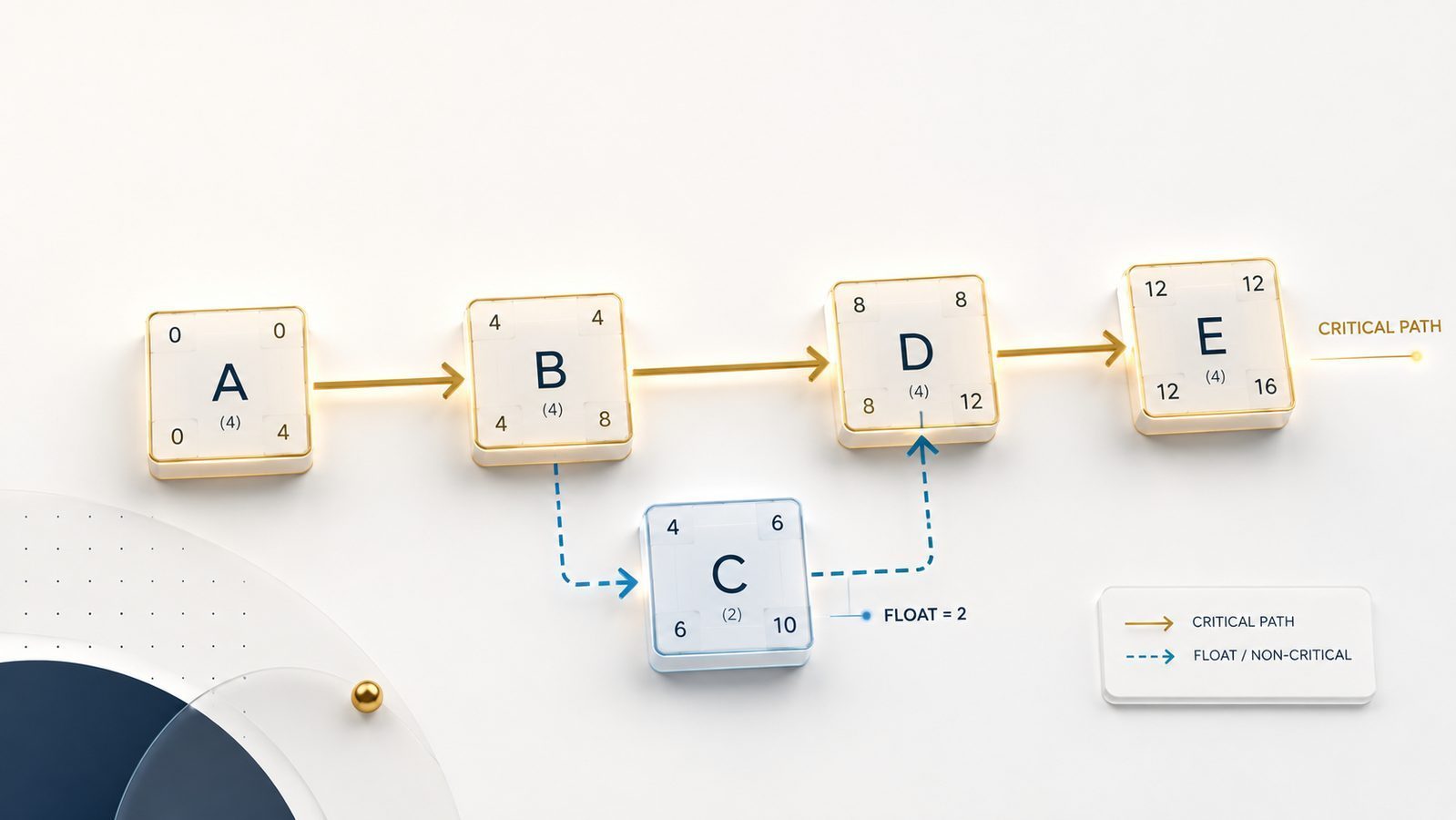
Open any PMP practice test and you will eventually hit a question with a small network diagram: boxes connected by arrows, a handful of durations, and an answer that asks you to name the critical path or calculate float for one activity. Many candidates who are otherwise strong on definitions freeze here. PMP critical path method questions are not hard because the math is advanced. They are hard because the steps have to be done in the right order, under time pressure, without a mistake compounding through the whole diagram. This article walks through that process once, cleanly, with a worked example you can reuse for practice.
Why Network Diagram Questions Still Matter on the 2026 Exam
The current PMP Examination Content Outline groups exam content into three domains: People, Process, and Business Environment, weighted at roughly 33%, 41%, and 26%. Schedule-related tasks sit inside the Process domain, which carries the largest share of the exam. The exam itself runs 180 questions over 240 minutes, made up of 170 scored items and 10 unscored pretest items, with two optional 10-minute breaks built into the session. PMI has also been shifting question formats toward more graphic-based and interactive items rather than pure recall, which is exactly the format a network diagram question takes: you are shown a small schedule and asked to interpret it, not to define a term.
That shift matters for how you prepare. Memorizing that "float equals late start minus early start" is not the same skill as looking at an unfamiliar diagram and applying that formula correctly under a two-minute mental clock. If you have already worked through the PMP exam format and question types, you already know these graphic and calculation questions are a distinct category worth practicing on their own, separate from situational judgment items.
How to Read a Network Diagram Before You Calculate Anything
Almost all PMP network diagrams use the activity-on-node format: each box represents one activity, and arrows show which activities must finish before others can start. Before doing any math, identify three things on the diagram: the start point, the finish point, and the dependency logic connecting each pair of activities. Most exam questions use simple finish-to-start relationships, meaning an activity cannot begin until its predecessor is complete. If you see anything labeled start-to-start, finish-to-finish, or start-to-finish, read it twice. Those relationships change how you calculate early start, and PMI uses them specifically to test whether you are pattern-matching or actually reading the diagram.
Once you understand the dependencies, you are ready for the two passes that solve every PMP critical path method question: the forward pass and the backward pass.
The Forward Pass: Calculating Early Start and Early Finish
The forward pass moves left to right through the diagram and calculates the earliest possible start (ES) and earliest finish (EF) for every activity. Here is a small worked example with five activities:
- Activity A: duration 3 days, no predecessor
- Activity B: duration 5 days, follows A
- Activity C: duration 4 days, follows A
- Activity D: duration 2 days, follows both B and C
- Activity E: duration 3 days, follows D
Starting the first activity at day 0, the forward pass looks like this: A has ES 0 and EF 3. B follows A, so its ES is 3 and its EF is 8. C also follows A, so its ES is 3 and its EF is 7. D follows both B and C, and when an activity has two predecessors, its early start equals the largest early finish among them, not the smallest. So D's ES is 8 (from B, not C), and its EF is 10. E follows D, giving it an ES of 10 and an EF of 13. The forward pass tells you the project's earliest possible finish is day 13, and it gives you the ES and EF for every activity, which you need for the next step.
The Backward Pass and Float: Finding the Critical Path
The backward pass moves right to left and calculates the latest finish (LF) and latest start (LS) for each activity without delaying the project. Start at the last activity and set its LF equal to its EF from the forward pass. E's LF is 13, so its LS is 10. D's LF equals E's LS, which is 10, so D's LS is 8. Because B and C both feed into D, their LF equals D's LS, which is 8. B's LS is then 3 (8 minus 5), and C's LS is 4 (8 minus 4). A's LF equals the smaller of B's and C's LS values, which is 3, giving A an LS of 0.
Float, sometimes called total float or slack, is the amount of time an activity can slip without delaying the project finish date. The formula is float equals late start minus early start, and it should give the same result as late finish minus early finish. Working through the example: A has float of 0, B has float of 0, C has float of 1 day, D has float of 0, and E has float of 0. Every activity with zero float sits on the critical path, so the critical path here is A-B-D-E, and the project takes 13 days. C is not on the critical path because it has one day of float; it could slip by one day without pushing back the finish date.
This is the pattern behind every PMP critical path method question, regardless of how many activities the diagram shows: forward pass for ES and EF, backward pass for LS and LF, subtract to get float, and the path with zero float everywhere is the critical path.
The Day 0 vs Day 1 Confusion, and Why It Rarely Matters
One detail trips up a lot of candidates who study from more than one source. Some materials start the first activity at day 0 (as shown above), while others start at day 1 and calculate EF as ES plus duration minus one. Both conventions appear in PMP prep resources, and the disagreement between them is a long-running debate in project scheduling references, not a sign that you are doing something wrong. The practical point for the exam: float and critical path identification come out the same either way, because both are calculated as differences between values, and a consistent one-day shift cancels out. Pick one convention, apply it consistently within a single question, and do not switch mid-calculation.
Common Mistakes That Cost Points on These Questions
A few errors show up repeatedly in PMP network diagram questions. The first is forgetting that when an activity has multiple predecessors, its early start takes the largest early finish among them, not the smallest or an average. The second is the mirror image on the backward pass: when an activity has multiple successors, its late finish takes the smallest late start among them. Mixing these up quietly produces a wrong critical path that still looks plausible.
The third mistake is assuming there is only ever one critical path. Diagrams can have two or more paths tied at zero float, and PMI can ask you to identify all of them or to explain what happens if a specific non-critical activity is delayed past its float. The fourth is treating every dependency as finish-to-start by default. If a question specifies start-to-start or finish-to-finish, the standard forward and backward pass logic still applies, but the offset calculations change, so slow down and reread the relationship before assuming a shortcut applies.
If you have already read through strategies for solving PMP questions quickly, the same pacing advice applies here: a network diagram question is worth spending an extra 30 to 60 seconds on if it means avoiding a careless arithmetic error, because these questions are graded the same as any other single-point item, but the multi-step calculation gives you more places to lose the point.
Where Critical Path Fits Alongside Other PMP Math Questions
Critical path and float calculations are a distinct question type from earned value management, even though both fall under quantitative, formula-based items on the exam. EVM questions ask about cost and schedule performance using variance and index formulas, while critical path questions ask you to trace dependency logic through a diagram. If EVM formulas like cost variance, schedule variance, and cost performance index are still shaky for you, it is worth reviewing them separately rather than mixing the two question types together while you practice, since the mental process for each is different.
Key Takeaways
- Every PMP critical path method question follows the same two-step process: a forward pass to find early start and early finish, then a backward pass to find late start and late finish.
- Float equals late start minus early start (or late finish minus early finish). Any activity with zero float sits on the critical path.
- When an activity has multiple predecessors, its early start uses the largest early finish among them. When an activity has multiple successors, its late finish uses the smallest late start among them.
- Whether you start counting at day 0 or day 1 does not change the float values or the identified critical path, as long as you are consistent within one calculation.
- Diagrams can have more than one critical path. Read carefully before assuming there is only one answer.
- Practice this as its own question type rather than lumping it in with EVM formulas. The two require different mental steps even though both are quantitative.
Practice Is What Makes This Stick
Reading through a worked example once will not make critical path questions automatic on exam day. The skill comes from doing this calculation enough times, on enough different diagram shapes, that the forward pass and backward pass become routine instead of something you have to think through from scratch. That kind of repetition, with immediate feedback on what you got wrong and why, is exactly what structured practice questions are for.
Our Practice Exam Simulator offers a huge variety of exam-style practice questions, including schedule and network diagram items, with detailed explanations for every answer. If you want to see where your critical path calculations actually stand, start with the free 20-question demo, no signup required, and go from there. Full access runs $39.99 for 90 days, which is enough time to work through your weak areas methodically rather than cramming the week before your exam.