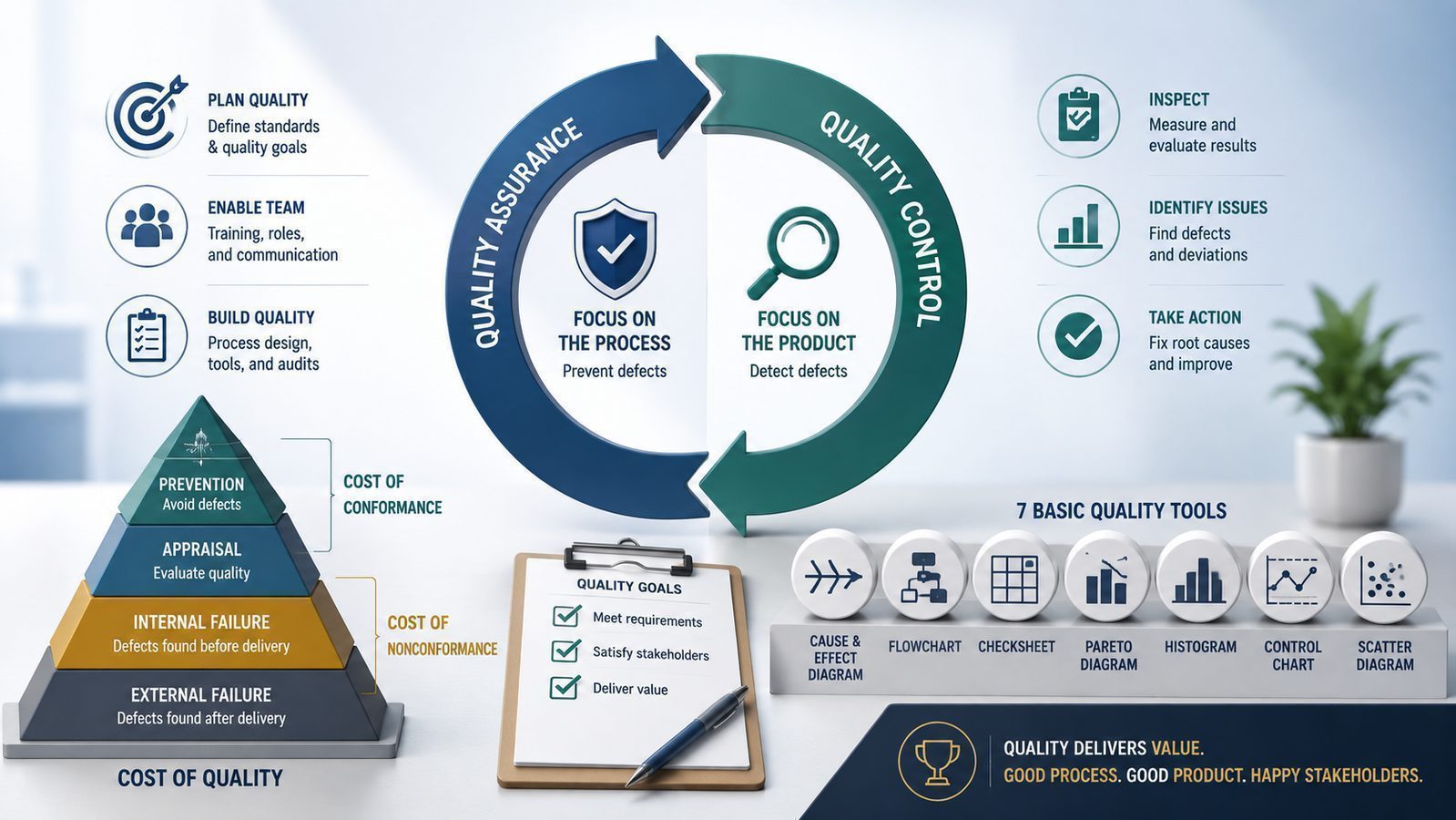
PMP quality management questions have a reputation for being easy to skim past and hard to actually get right. On paper, quality sounds like common sense: build things correctly, catch problems early, keep customers happy. On the exam, that same content shows up as a scenario where a process is broken, a deliverable failed inspection, or a stakeholder wants to add testing steps late in the project, and you have to pick the one response that matches how PMI defines quality assurance, quality control, and cost of quality. Candidates who studied the theory but never practiced applying it to a scenario tend to lose points here in a way that surprises them. This article walks through the concepts that actually drive these questions and the reasoning PMI expects you to use.
Why Quality Management Questions Trip Up Predictive-Minded Candidates
The current PMP Examination Content Outline organizes the exam into three domains: People, Process, and Business Environment, weighted at roughly 33%, 41%, and 26%. Quality-related tasks sit mainly inside the Process domain, alongside schedule, cost, and risk, which is the largest single share of the exam. The exam itself runs 180 questions over 240 minutes, made up of 170 scored items and 10 unscored pretest items, with two optional 10-minute breaks built into the session.
What makes quality management questions distinct from formula-heavy topics like earned value or critical path is that most of them are not calculations. They are judgment calls dressed up as scenarios: a team member wants to skip a review step to save time, a customer complains about a defect after delivery, or a project manager has to decide whether a recurring problem needs more inspection or a different process. If you have already worked through PMP risk management questions, the pattern will feel familiar: PMI is testing whether you apply the right concept to the right situation, not whether you can recite a definition.
Quality Assurance vs Quality Control: The Rule That Solves Half These Questions
The single most useful distinction in this topic is the difference between quality assurance and quality control, which PMBOK frames as the Manage Quality process and the Control Quality process. Manage Quality is about the process: auditing how the team works, improving standards, and preventing defects before they happen. Control Quality is about the product: inspecting, testing, and measuring the actual deliverable to confirm it meets requirements.
A simple rule holds up across nearly every question of this type: if the scenario describes a problem with how the work is being done, the answer points toward quality assurance. If the scenario describes a defect found in something the team already produced, the answer points toward quality control. A question about auditing a vendor's process, updating a checklist, or training the team on a new standard is a Manage Quality question. A question about a failed weld, a bug found in testing, or a customer returning a defective unit is a Control Quality question. Read the scenario for whether it is describing a process or a product, and the right process usually follows.
Cost of Quality: Prevention, Appraisal, and the Two Kinds of Failure
Cost of quality questions ask you to categorize a specific cost into one of four buckets: prevention, appraisal, internal failure, or external failure. Prevention costs are spent to avoid defects in the first place, things like training, process design, and quality planning. Appraisal costs are spent to measure and evaluate whether the work meets standards, such as inspections, testing, and audits. Internal failure costs happen when a defect is caught before the customer ever sees it, meaning rework, scrap, and repair done inside the project. External failure costs happen when the defect reaches the customer, and they tend to include warranty claims, returns, and damage to reputation on top of the direct cost of fixing the problem.
PMI groups these into two larger categories worth knowing by name. The cost of conformance covers prevention and appraisal spending, the money spent to make sure quality happens. The cost of nonconformance covers internal and external failure spending, the money spent because it did not. The general principle behind cost of quality questions is that PMI wants project managers to spend more on conformance early, because failure costs, especially external ones, tend to be far more expensive to absorb than the cost of catching a problem before it ships. When a question asks you to identify which spending category is "cheapest" or which a project manager should prioritize, prevention is almost always the intended direction, since it addresses root cause rather than reacting to a defect that already exists.
The Seven Basic Quality Tools You Need to Recognize, Not Memorize by Heart
PMP quality management questions occasionally show you a chart or diagram and ask what it is or what it tells you. PMBOK groups seven tools together for this purpose: cause-and-effect diagrams (also called fishbone or Ishikawa diagrams), flowcharts, checksheets, Pareto diagrams, histograms, control charts, and scatter diagrams. You do not need to draw any of these from memory. You need to recognize what each one is for when a scenario describes it.
A cause-and-effect diagram is for tracing a defect back to its possible root causes, branching out from the problem like bones on a fish. A checksheet is a simple tally used to confirm that a series of steps happened consistently. A Pareto diagram is a bar chart that ranks causes by how much of the problem they account for, built around the idea that a small number of causes usually drive most of the effect. A control chart tracks a process over time against upper and lower control limits, and it is the tool to reach for whenever a question describes a process going out of a defined range. A histogram shows how quality data is distributed. A scatter diagram plots two variables against each other to see whether they are related. A flowchart maps the sequence of steps in a process so a team can see where a defect might be entering. If a question describes what the diagram is doing rather than naming it directly, work backward from the description to the tool, the same way you would work backward from a symptom to a root cause.
How Quality Questions Show Up in Agile and Hybrid Scenarios
Quality management is not confined to predictive projects, and the exam reflects that. In agile and hybrid environments, the same principles apply but the mechanics shift: instead of a formal Control Quality process at set milestones, quality gets checked continuously through practices like test-driven development, definition of done, retrospectives, and frequent demos to the customer. A scenario where a Scrum team catches a defect during a sprint review and adjusts its definition of done for the next sprint is testing the same underlying concept as a traditional Control Quality question, just wrapped in agile language. If you have already read through the reasoning in agile vs waterfall for the PMP exam, the same instinct applies here: identify the underlying project management concept first, then map it onto whatever methodology the scenario describes.
One detail worth remembering for hybrid scenarios: quality assurance in agile is often described as being built into the team's working agreements and definition of done rather than run as a separate audit function. That does not make quality assurance disappear, it just means the exam may frame a Manage Quality question as "the team agreed to add automated testing to their workflow" rather than "the project manager scheduled a process audit." The underlying logic, process improvement to prevent future defects, is the same.
Key Takeaways
- Quality assurance (Manage Quality) is about fixing the process to prevent defects. Quality control (Control Quality) is about inspecting the product to catch defects. Process problem points to QA, product defect points to QC.
- Cost of quality has four categories: prevention and appraisal (cost of conformance), plus internal and external failure (cost of nonconformance). Prevention spending is generally the answer PMI wants when a question asks what to prioritize.
- The seven basic quality tools are cause-and-effect diagrams, flowcharts, checksheets, Pareto diagrams, histograms, control charts, and scatter diagrams. Learn what each one is used for rather than memorizing a list.
- Control charts are the tool to recognize whenever a scenario describes a process drifting outside acceptable limits over time.
- Quality concepts apply just as much in agile and hybrid scenarios, usually expressed through definition of done, continuous testing, and retrospectives rather than a separate formal audit.
- Most quality management questions are judgment scenarios, not calculations. Practice reading the situation for whether it describes a process or a product before choosing an answer.
Practice Is What Turns Quality Concepts Into Exam-Day Instinct
Reading the difference between quality assurance and quality control once will not make it automatic when you are facing an unfamiliar scenario under a countdown timer. The skill comes from working through enough varied examples that recognizing "process problem versus product defect" and "which cost of quality bucket" becomes instinctive rather than something you have to reason through from scratch. Pairing this with quantitative topics like the ones covered in the core PMP formulas for 2026 gives you a fuller picture of how the Process domain gets tested.
pmproad.com offers over 1,100 exam-style practice questions, including PMP quality management questions and scenarios, with detailed explanations for every answer. If you want to see where your understanding of quality assurance, quality control, and cost of quality actually stands, start with the free 20-question demo, no signup required, and go from there. Full access runs $39.99 for 90 days, which is enough time to work through your weak areas methodically rather than cramming the week before your exam.