If you have taken a full-length practice exam and watched your score drop every time a risk question shows up, you are not alone. PMP risk management questions ask you to do two things at once: apply a formula correctly and choose the response PMI considers most appropriate for the situation. Most candidates can do one or the other. The exam wants both, often in the same question.
This guide breaks down how risk management is tested on the current PMP exam, what the numbers actually mean when you calculate expected monetary value, and how to prepare for the scenario-based risk questions that now make up a larger share of the test.
Where Risk Management Sits in the Current PMP Exam
Since PMI's revised Examination Content Outline took effect on July 9, 2026, the exam has kept its familiar shape: 180 questions, 240 minutes, and two optional 10-minute breaks. What changed is the mix. Ten of those 180 questions are now unscored pretest items instead of five, and the balance across the three domains shifted. People now accounts for roughly 33% of the exam, Process for roughly 41%, and Business Environment for roughly 26%, up from about 8% under the previous outline. Sources differ slightly on the exact percentages, so treat these as approximate and confirm against PMI's published outline if you want the precise figures for your study plan.
Risk management questions live mostly inside the Process domain, since that domain covers the technical mechanics of planning, scheduling, budgeting, and risk response. But risk shows up elsewhere too. A question about a stakeholder pushing back on a mitigation plan tests People. A question about how a new regulation changes your risk exposure tests Business Environment. This is one reason candidates underestimate how often risk material appears: it is not confined to one section, it is woven through the exam.
The other shift worth knowing about is the balance between predictive and agile-hybrid content. PMI now weights roughly 60% of the exam toward agile and hybrid approaches, which changes how risk questions get framed. A predictive-style question might ask you to update a risk register after a schedule slip. An agile-style question might ask what you do when a new risk surfaces mid-sprint. Read the full breakdown of the exam changes in our article on PMP exam changes for July 2026 if you want the complete domain and format picture before you dig into risk specifically.
The Risk Response Strategies PMI Expects You to Know
Most candidates memorize the list of risk response strategies and then freeze when a scenario question asks them to apply one. The list itself is not complicated.
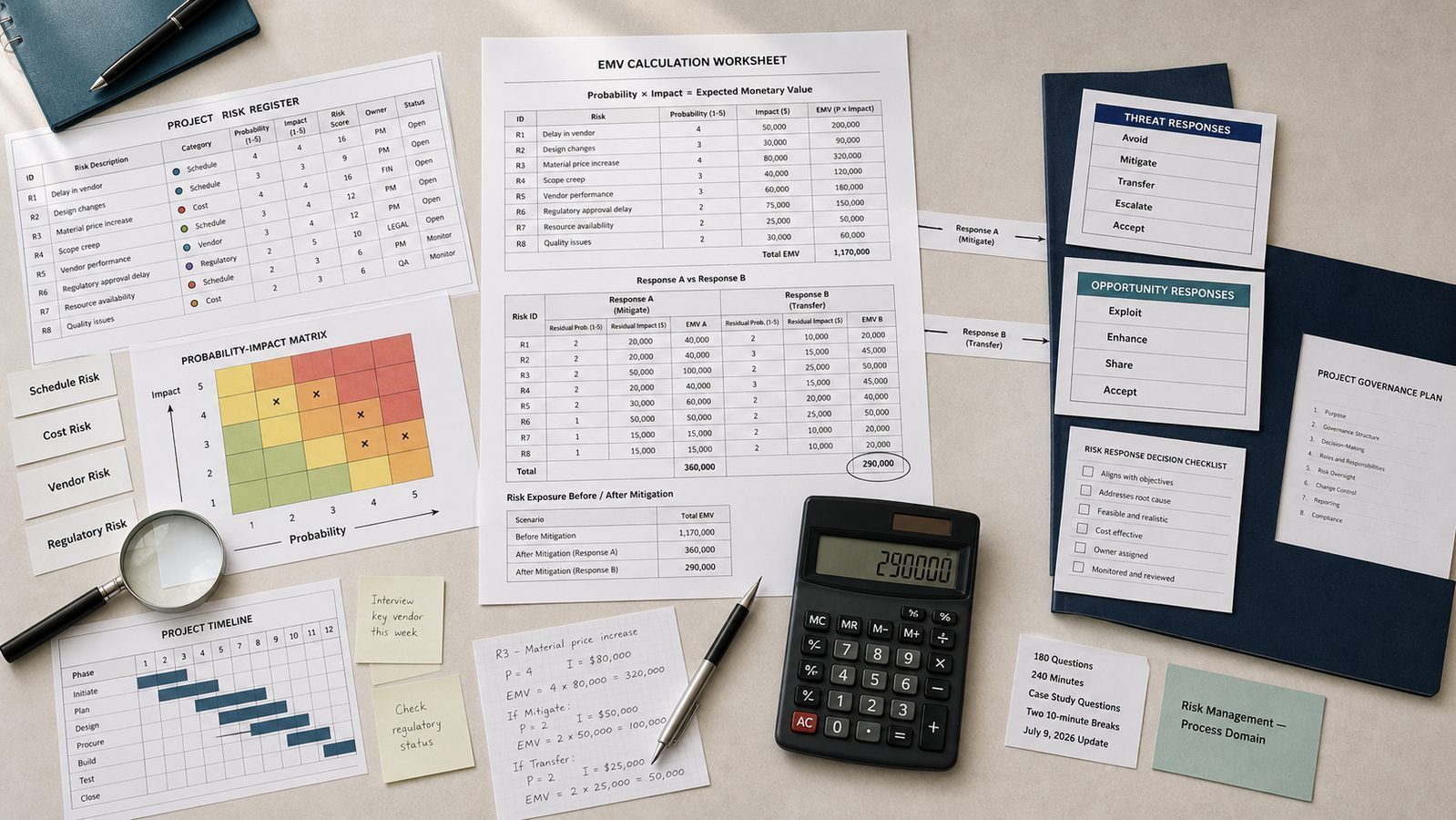
For negative risks, or threats, PMI recognizes five strategies: avoid, mitigate, transfer, escalate, and accept. Avoid means you change the plan to remove the risk entirely. Mitigate means you reduce the probability or impact without eliminating it. Transfer means you shift the financial consequence to a third party, such as through insurance or a contract clause. Escalate means the risk is outside your authority or the project's scope, so you hand it to whoever can actually manage it. Accept means you acknowledge the risk and do nothing further, sometimes setting aside a contingency reserve in case it happens.
For positive risks, or opportunities, the mirror strategies are exploit, enhance, share, escalate, and accept. Exploit means you take action to make sure the opportunity happens. Enhance means you increase the probability or impact of a positive outcome. Share means you partner with another party who is better positioned to capture the benefit. Escalate and accept work the same way they do for threats.
Where candidates lose points is not in recalling this list. It is in choosing the right strategy for the situation described. PMI's scenario questions are built to make two or three answers look plausible. The strategy that wins is usually the one that matches the level of urgency and authority implied in the question. If the scenario says a vendor delay would derail the whole project and you have contract leverage, transfer or mitigate usually beats accept. If the scenario says the risk is minor and low-probability, accept usually beats an expensive mitigation plan that is not proportional to the risk.
Expected Monetary Value and Quantitative Risk Questions
Expected monetary value, or EMV, is the calculation most candidates dread, even though the math itself is simple: multiply the probability of an outcome by its financial impact, then add the results together if there is more than one possible outcome. A risk with a 20% chance of causing a $50,000 cost overrun has an EMV of $10,000. A risk with an 80% chance of saving $5,000 has an EMV of $4,000, expressed as a positive value since it represents an opportunity.
EMV becomes useful on the exam when a question asks you to compare two response strategies and pick the one with the better expected outcome. Say a risk response costs $15,000 to implement but reduces the EMV of the underlying risk from $30,000 down to $8,000. The net benefit is $30,000 minus $8,000 minus $15,000, or $7,000 in your favor. If a competing strategy costs less but only reduces the EMV to $20,000, you would compare the net benefit of each option rather than picking the cheaper one automatically.
This is the part candidates miss most often: PMI is rarely testing whether you can do the arithmetic. It is testing whether you understand what the number tells you about which decision creates more value for the project. If you want a refresher on the other formulas that show up alongside EMV, including cost and schedule performance calculations, our article on PMP math questions and the formulas you need for 2026 covers the broader set you should have ready.
How Scenario and Case Study Questions Test Risk Thinking
The July 2026 outline introduced case study question sets, where a multi-paragraph project scenario is followed by three to five linked questions. Risk management is a natural fit for this format because real risk decisions rarely happen in isolation. A single scenario might describe a project with a tight budget, a new regulatory requirement, and a vendor that has missed two milestones, then ask you to identify the risk category, select a response strategy, and decide how to communicate the change to the sponsor, all based on the same set of facts.
This format rewards candidates who can hold the whole scenario in mind rather than answering each question as if it were standalone. If question two of a case study set assumes you already decided to escalate the vendor risk, but you answer question three as though you chose to accept it instead, you will get the sequence wrong even if your individual reasoning was sound.
Graphic-based questions are also part of the mix. You might be shown a probability-impact matrix or a partial risk register and asked to interpret it, for example identifying which risk has the highest priority score or which one is missing a response owner. These questions test whether you can read project artifacts quickly, which is exactly what you do on a real project when a risk review meeting starts in five minutes and you have not had time to prepare.
If your background leans heavily predictive or heavily agile, risk scenarios can expose the gap. A candidate used to formal risk registers may default to slow, document-heavy responses in an agile scenario where the better answer is to raise the risk at the next stand-up and adjust the backlog. Our piece on agile versus waterfall on the PMP exam goes deeper into how PMI expects you to switch mental models depending on the delivery approach described in the question.
A Practical Way to Study Risk Management Questions
Start by separating the two skills the exam is testing. First, know the vocabulary and the formulas cold: the five threat responses, the five opportunity responses, EMV, and the difference between qualitative and quantitative risk analysis. Flashcards work fine for this part because it is recall, not judgment.
Second, practice applying that vocabulary to scenarios, ideally scenarios you did not write yourself. This is where most self-study plans fall short, because it is easy to reread notes and feel confident without ever testing whether you can pick the right answer under exam conditions. Timed practice questions that mix risk topics with unrelated domains are more useful here than a risk-only quiz, since the real exam never tells you in advance which domain a question belongs to.
Third, review your wrong answers by asking what detail in the scenario you missed, not just whether you got the concept right. Nearly every missed risk question on a practice exam comes down to overlooking a word like "immediately," "first," or "before escalating," which changes which response strategy actually fits.
Key Takeaways
- Risk management questions are concentrated in the Process domain but also appear inside People and Business Environment scenarios, so do not study risk as an isolated topic.
- Know all five threat responses (avoid, mitigate, transfer, escalate, accept) and all five opportunity responses (exploit, enhance, share, escalate, accept), and practice matching them to scenario details rather than memorizing the list alone.
- EMV is a comparison tool. The exam usually wants you to weigh the net benefit of one response against another, not just calculate a single number.
- Case study sets require you to track earlier answers within the same scenario. Treat each set as one connected decision, not several unrelated questions.
- If your work background is mostly predictive or mostly agile, deliberately practice risk scenarios from the other approach, since the exam weights agile and hybrid content heavily.
- Review missed practice questions for the specific word or detail you overlooked, not just the concept you think you got wrong.
Put This Into Practice
Reading about risk response strategies is different from choosing the right one under time pressure with a scenario you have never seen before. That gap is exactly what practice questions are for. pmproad.com offers 1,100+ exam-style questions with detailed explanations, including risk management scenarios that mirror the case study and graphic-based formats now on the exam. Start with the free 20-question demo, no account required, and see how risk questions specifically are landing for you before you commit to a study plan.