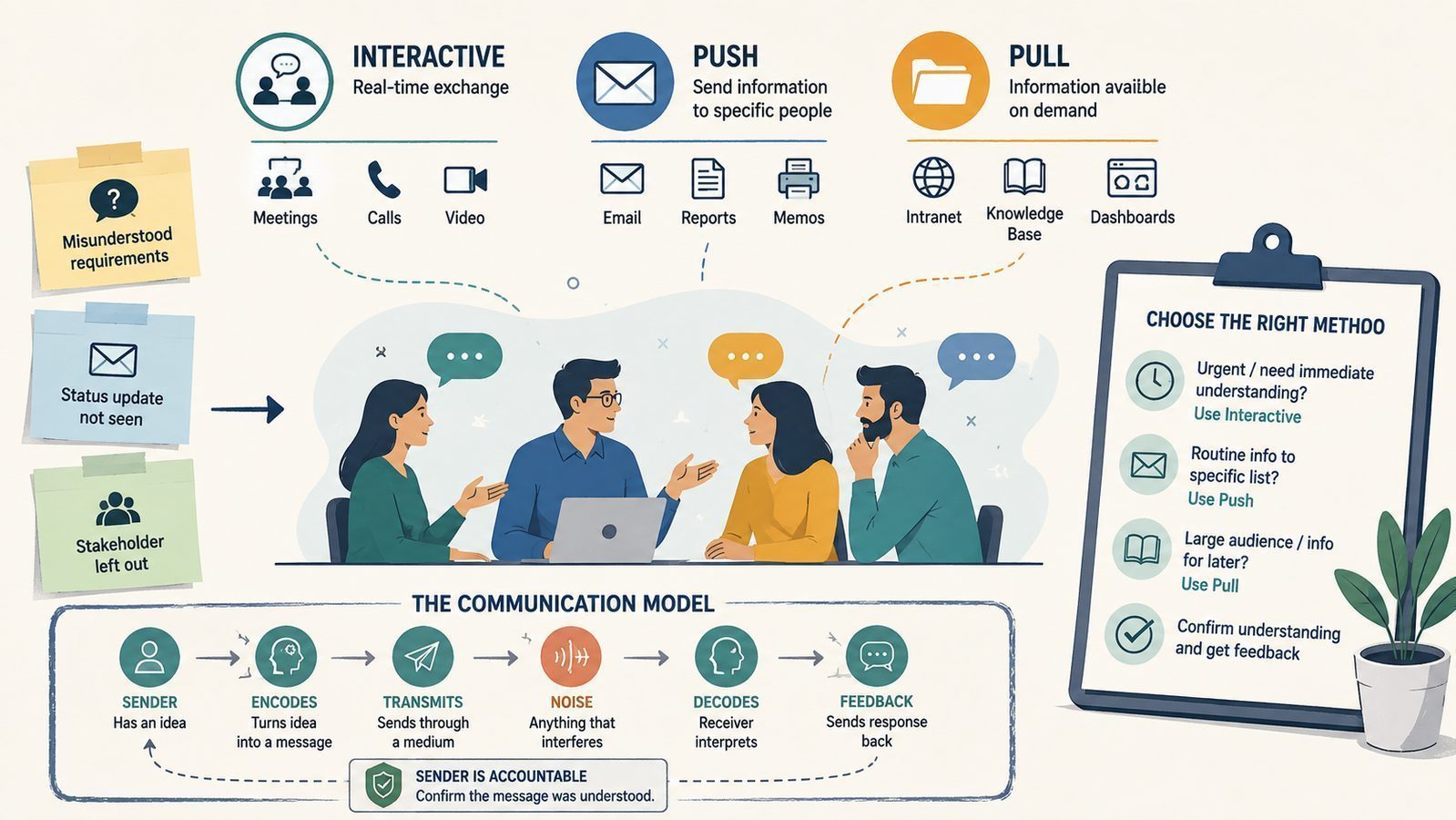
PMP communications management questions rarely look like communications questions. They show up disguised as a scenario where a sponsor says they were never told about a schedule slip, a remote developer misreads a requirement, or a stakeholder complains about being left out of a decision, and you have to pick the answer that matches how PMI defines communication methods, the communication model, and how a project manager is supposed to choose between them. Candidates who treat this topic as common sense, because talking to people feels intuitive, tend to lose points here for the same reason they lose points on risk or quality questions: the exam is testing a specific framework, not general people skills. This article walks through what actually drives these questions and the reasoning PMI expects you to apply.
Why Communications Questions Trip Up Experienced Project Managers
The current PMP Examination Content Outline organizes the exam into three domains: People, Process, and Business Environment, weighted at roughly 33%, 41%, and 26%. Communications does not get its own domain the way it did in older PMBOK editions with a standalone knowledge area chapter, but it runs through both People (engaging stakeholders, building shared understanding, resolving conflict) and Process (the technical work of planning and executing a communications approach). The exam itself runs 180 questions over 240 minutes, made up of 170 scored items and 10 unscored pretest items, with two optional 10-minute breaks built into the session, part of the broader shift covered in what changed on the PMP exam in July 2026.
Experienced project managers often underperform on this topic precisely because they are good at communication in practice. They answer scenario questions based on what they would actually do on the job, which is frequently more improvised and situational than what PMI is testing for. The exam wants you to recognize a small number of named concepts, the three communication methods, the sender-receiver model, and the factors that drive method selection, and apply them consistently. If you have already worked through PMP risk management questions, the pattern will feel familiar: PMI rewards matching the right named concept to the right situation, not just doing the reasonable thing.
The Three Communication Methods Behind Most PMP Communications Management Questions
PMBOK groups communication into three methods, and almost every scenario question is quietly asking you to identify which one applies. Interactive communication is a real-time exchange between two or more parties: meetings, phone calls, video conferences, and in-person conversations. It is the method PMI wants when a situation requires confirming shared understanding immediately, resolving a disagreement, or negotiating a decision. Push communication sends information to specific recipients without requiring their immediate engagement: emails, memos, status reports, and faxes (yes, faxes still show up in prep materials). It works for distributing information broadly but does not, by itself, confirm that anyone read or understood it. Pull communication places information somewhere recipients can retrieve it on their own schedule: an intranet site, a shared knowledge base, a project dashboard. It suits large volumes of information that not everyone needs right away.
The pattern that solves most of these questions: if the scenario emphasizes urgency, disagreement, or the need to confirm understanding on the spot, the answer is interactive communication, usually a meeting or call rather than another email. If the scenario describes routine status information going to a defined list of people who do not need to respond immediately, push communication is the answer. If the scenario describes a large or undefined audience accessing reference material at their own convenience, pull communication fits. A question that describes a stakeholder repeatedly missing information sent by email is often testing whether you will recognize that push communication failed and an interactive conversation is now the more appropriate method, not whether you will suggest sending another email.
The Communication Model PMI Expects You to Know
Behind the three methods sits a more basic model that shows up in scenario questions about miscommunication. A sender encodes an idea into a message, transmits it through a medium, and a receiver decodes it on the other end. Noise, which PMI defines broadly as anything that distorts or interferes with the message, can interfere at any point: technical jargon the receiver does not know, language or cultural differences, time zone lag, poor audio on a call, or simply a distracted reader. The receiver then typically sends feedback, which is itself encoded, transmitted, and decoded, completing the loop.
The detail that decides a lot of these questions is where PMI places responsibility. The sender is accountable for confirming the message was understood, not just for sending it. A scenario where a project manager emails a change to the team and later discovers half the team missed it is not, in PMI's framing, primarily a problem with the team member who did not read carefully. It is a problem with the sender choosing a method (push) that never confirmed receipt or understanding for information that needed confirmation. When a question asks what the project manager should have done differently, the answer usually points back to method selection: use interactive communication, or at minimum request explicit confirmation, whenever the content matters enough that a misunderstanding would cause real damage.
How to Choose the Right Communication Method on Exam Day
PMI names five factors that should influence which communication method and technology a project manager selects for a given message: urgency of the information, availability of the technology to all recipients, ease of use for the audience, the project environment (co-located, distributed, or hybrid), and the sensitivity or confidentiality of the content. Scenario questions tend to isolate one factor at a time. A question describing a distributed team across multiple time zones is pointing at project environment, and the answer usually favors asynchronous or pull methods for non-urgent content, since forcing a synchronous meeting across too many time zones creates its own problem. A question describing a personnel issue or a contract dispute is pointing at sensitivity, and the answer usually favors a private, interactive conversation rather than a written channel that could be forwarded or misread. A question describing an urgent safety issue is pointing at urgency, and the answer favors the fastest reliable interactive method available, a call rather than an email.
The trap in these questions is picking the method you would personally reach for out of habit rather than the one the specific factor in the scenario calls for. Read for which of the five factors the question is actually testing before you choose an answer, since two similar-looking scenarios can have different correct answers depending on whether the emphasis is on urgency or on confidentiality.
The Communication Channels Formula, and When You Actually Need It
The communication channels formula, n(n-1)/2, where n is the number of people on the team including the project manager, occasionally appears directly as a calculation question. More often it shows up conceptually, in a scenario asking why adding a few more stakeholders to a project made communication noticeably harder to manage. The value of the formula is not the arithmetic, it is the reminder that the number of potential communication lines grows much faster than the number of people, which is exactly why communications planning gets disproportionately harder as a project scales or a team grows. If you want to practice the calculation itself alongside the other formulas most likely to appear on the 2026 exam, this breakdown of essential PMP formulas walks through worked examples step by step.
Key Takeaways
- The three communication methods are interactive (real-time, confirms understanding), push (sent to specific recipients, no guarantee of receipt), and pull (self-service, for large or undefined audiences). Match the method to what the scenario needs, not to habit.
- The sender is responsible for confirming the message was understood, not just for sending it. A scenario where information got lost is usually testing whether you recognize a method-selection failure.
- Noise is anything that distorts a message: jargon, language differences, time zone lag, poor audio, distraction. It can interfere at any point between sender and receiver.
- Five factors drive communication method selection: urgency, technology availability, ease of use, project environment, and sensitivity or confidentiality. Identify which factor a question is isolating before choosing an answer.
- The channels formula n(n-1)/2 matters less for the arithmetic and more for the underlying idea that communication complexity grows faster than team size.
- Most communications management questions are judgment scenarios built around a small set of named concepts, not general communication advice. Practice recognizing which concept is being tested.
Turning These Concepts Into Exam-Day Instinct
Reading through the three communication methods once will not make them automatic when a scenario question buries the relevant detail in a paragraph of context under a countdown timer. The skill comes from working through enough varied examples that spotting "this needs interactive communication" or "this is a sensitivity problem, not an urgency problem" becomes fast rather than something you reason through from scratch each time.
pmproad.com offers over 1,000 exam-style practice questions, including scenarios built around communications management, stakeholder engagement, and the other People and Process domain concepts covered here, each with a detailed explanation of why the correct answer is correct. If you want to see where your instincts on these scenarios actually stand, start with the free 20-question demo, no signup required, and go from there. Full access runs $39.99 for 90 days, which is enough time to work through your weak areas methodically rather than cramming the week before your exam.