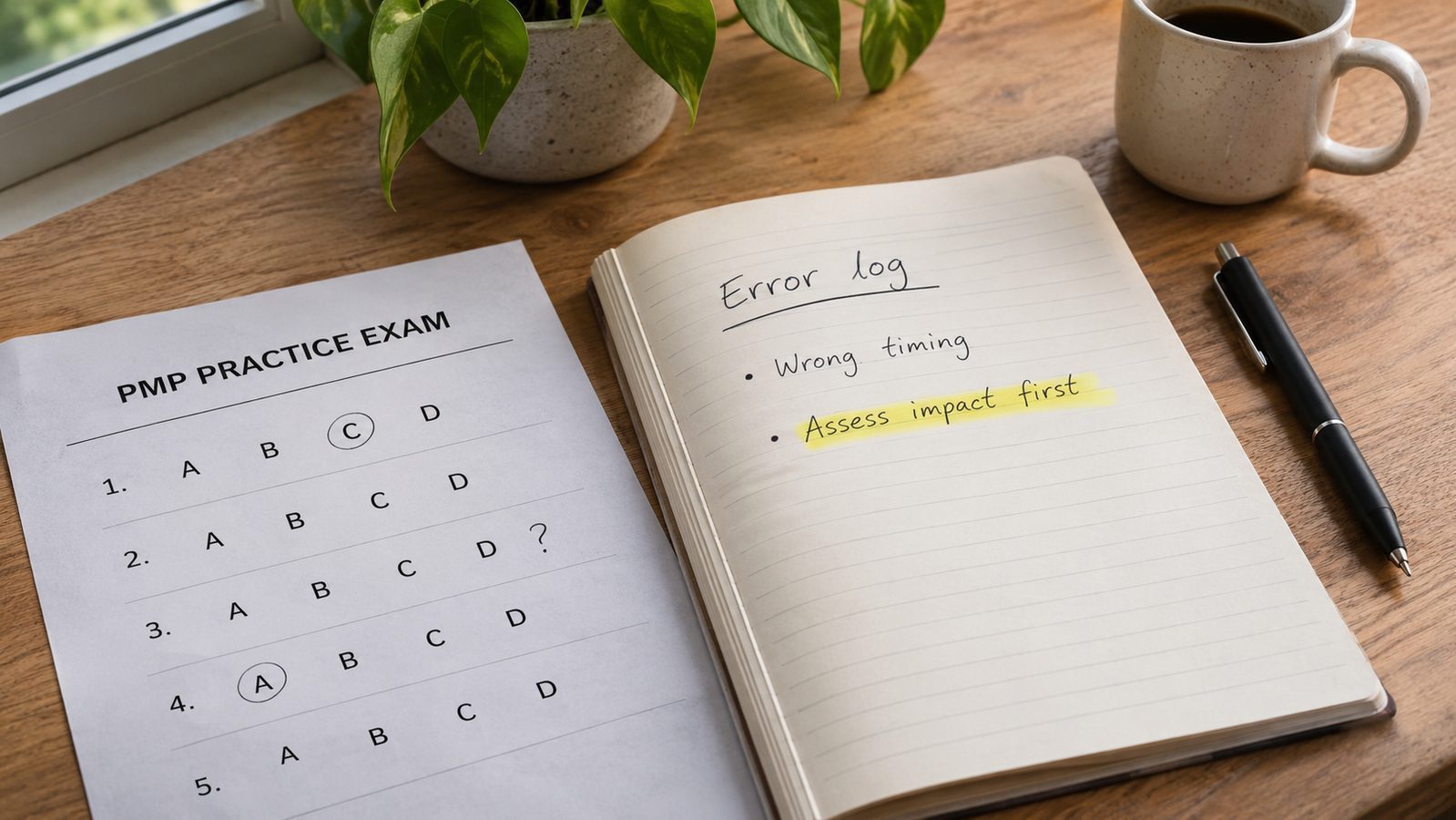
You finished a full-length mock exam, checked the score, felt either relieved or discouraged, and moved on to the next set of questions. If that sounds familiar, you are leaving most of the value of your practice on the table. Knowing how to review PMP practice exam mistakes is one of the highest-return skills in your preparation, because the score tells you where you stand, but the review tells you what to change.
This article is for candidates who are already doing practice questions and want the numbers to move. You will get a four-step review method, a simple way to find your real weak spots across the three exam domains, and a realistic way to schedule review time around a full-time job.
Why Reviewing Matters More Than Doing More Questions
It is tempting to treat practice questions like a volume game: more questions, more exposure, higher score. Volume helps, but only when each question teaches you something. If you read the explanation for a missed question, nod, and continue, the same reasoning error will probably return in a different scenario next week.
The reason is how the exam is built. PMI describes the PMP exam as 180 questions, and its published sample items are scenario-based multiple-choice questions with four options and one best answer. In a scenario question, several options often sound reasonable. You are not being tested on whether you recognise a term; you are being tested on whether you choose the best action in context. A wrong answer is therefore rarely a missing fact. More often it is a flawed way of reading the situation: acting before analysing, skipping the sponsor or the team, or applying a predictive habit to an agile scenario.
That is why a wrong answer is useful data. It points to a specific reasoning pattern, and patterns can be fixed. If you want to see how this fits with the wider debate about mindset versus practice, our article on PMI mindset versus practice questions covers it in detail.
Step 1: Sort Every Question Into Three Piles
Do not review only the questions you got wrong. Right answers can hide weak understanding. After a practice session, sort each question into one of three groups:
- Solid: you got it right and can explain in one sentence why the best answer beats the others.
- Lucky or shaky: you got it right, but you guessed, or you narrowed it to two options and picked one without a firm reason.
- Wrong: you chose an incorrect option.
Only the second and third piles need study. The second pile is the one most candidates skip, and it matters because a correct guess on a practice test is a wrong answer waiting to happen on the real exam. Mark these questions while you answer, not afterwards. A quick flag when you feel unsure is far more reliable than your memory of how confident you were an hour later.
This also changes how you read your score. A practice result made up of many shaky correct answers is weaker than the percentage suggests.
Step 2: Write Down Your Reasoning, Then Name the Trap
For each question in the shaky and wrong piles, do two short things before you look at the explanation for too long.
First, write one sentence describing what you were thinking when you chose your answer. Not the correct reasoning, your actual reasoning. For example: "I picked the option that updates the risk register because documentation seemed important." This sentence is the most valuable part of the review, because it exposes the habit behind the mistake.
Second, name the trap. Every wrong option is attractive for a reason. Ask yourself which of these your choice fell into:
- Right action, wrong moment. The option is sensible, but something else should happen first, such as analysing the impact before making a change.
- Right action, wrong person. You, as the project manager, chose to do something that belongs to the sponsor, the team, or the change control board.
- Wrong approach for the context. A predictive tool or process was chosen for an agile or hybrid scenario, or the reverse.
- Escalating too early. You went to the sponsor before trying to resolve the issue within your own authority.
- Passive response. You chose to wait, monitor, or document when the scenario called for action.
These categories are my own working labels, not an official PMI list, but they cover many of the situational mistakes candidates report. Once you start naming traps, you will notice that the same two or three keep appearing. That recurring pattern is your real study target.
Step 3: Build a PMP Error Log and Tally by Domain
A PMP error log does not need to be elaborate. A spreadsheet or notebook with five columns is enough:
- Topic or knowledge area (for example, risk, scope, stakeholder engagement)
- Exam domain (People, Process, or Business Environment)
- Your reasoning in one sentence
- The trap you fell into
- The rule you will apply next time, written in your own words
The last column is what makes the log useful. "Assess impact before approving a change" is a rule you can recall under time pressure. "Question 47 was about change requests" is not.
Use the domain weights to prioritise
After two or three practice sessions, count your logged errors by domain and by topic. Then compare the pattern to the exam blueprint. According to PMI, the exam weights since July 2026 are People 33 percent, Process 41 percent, and Business Environment 26 percent, compared with the previous 42, 50, and 8 percent. The Business Environment domain is now a much larger part of the exam than it used to be, so errors there deserve more weight than they would have under older study materials. For a fuller breakdown of the weights, see our guide to PMP exam domains in 2026.
If you are using older books or question banks written for the earlier outline, expect them to under-represent business environment topics. Your error log will often show this as a cluster of mistakes in questions about organisational change, compliance, benefits, and value delivery. When that happens, treat it as a signal to add targeted material, not as bad luck.
Be careful with small samples. If you have logged only a handful of errors, a pattern may just be noise. Treat the tally as a hypothesis until it repeats across several sessions.
Step 4: Rewrite the Question to Prove You Understand It
Here is a test that works well for shaky questions. After reading the explanation, change one detail in the scenario so that a different option becomes the best answer. For example, if the original question had a team of experienced agile practitioners, imagine a team new to the approach. Or imagine that the change has already been approved. Ask yourself which option would win now and why.
If you can do this, you understand the principle behind the question. If you cannot, you have probably memorised the answer, and you will struggle when the real exam presents the same concept in a different setting. This matters even more with the scenario sets that appear in the current exam format, where one situation leads to several linked questions. Our guide to PMP case study questions explains how those sets work and why reading the scenario carefully pays off.
Rewriting takes a few minutes per question, so use it selectively. Reserve it for questions in your shaky pile and for the topics that keep appearing in your error log.
Fitting the Review Into a Working Week
Review takes real time, and it is easy to skip when your days are full. A few practical guidelines:
- Plan review time before you plan question time. A common recommendation among exam prep writers is that review should take as long as, or longer than, the questions themselves. I cannot point to a study that proves an exact ratio, so treat this as a sensible rule of thumb rather than a measured fact.
- Review while the session is fresh. Your memory of why you chose an answer fades quickly. Aim to review on the same day.
- Use short sessions for short questions. Twenty minutes of focused review on ten questions beats an hour of skimming explanations.
- Revisit the log weekly. Read through the "rule" column, then retry a few old missed questions after several days. If you now answer them correctly and can state why, move on. If not, the topic needs another pass with fresh material.
If you are balancing preparation with a demanding job, our guide on how to pass the PMP exam while working full-time shows how to fit this kind of review into limited study hours. And if you have already taken the exam once, the same method is the backbone of a good PMP retake plan.
Key Takeaways
- The value of practice comes from review, not volume. A missed question is information about how you reason.
- Sort questions into solid, shaky, and wrong. Shaky correct answers deserve review just as much as wrong ones.
- Write your actual reasoning and name the trap behind the wrong choice. Recurring traps are your real weaknesses.
- Keep a simple error log with a rule in your own words, and tally errors by domain against the current weights: People 33 percent, Process 41 percent, Business Environment 26 percent.
- Test your understanding by changing one detail in a scenario and predicting the new best answer.
- Review the same day, in short focused sessions, and revisit your log every week.
Put Your Review Method to Work
The next step is to apply how to review PMP practice exam mistakes to real questions, not just read about it. Pick a set of exam-style questions, flag the ones you are unsure about, and run them through the four steps above. After a couple of sessions your error log will show you where your points are hiding.
If you are looking for material to practise on, pmproad.com offers 1,100+ exam-style questions with detailed explanations, plus Practice Mode, Exam Mode, and progress tracking so you can see your weak areas by topic. Start with the free 20-question demo, with no commitment required, and use it as your first entry in the error log.